Version: 0.5 (Q1, 2026)
Measuring Moral Governance Across Countries
Introduction
A nation is more than its territory, economy, or military power. It is a living community of people, bound together by history, culture, and shared institutions. And like any community, it possesses a moral character—shaped by the choices of its citizens and the leaders they elect.
Righteousness, in this context, is internal. It lives in the hearts and convictions of a people. It is expressed through:
- The moral decisions of the people — how they treat one another, what they demand from their leaders, whether they stand for justice or remain silent in the face of wrong.
- The moral decisions of elected leaders — the laws they pass, the policies they pursue, whether they govern with integrity or exploit their power.
- The relationship between the two — leaders shape the moral direction of a nation, but they are also shaped by the people who elect them. A righteous nation requires both.
This inner moral life is what we call righteousness.
It is distinct from ethics, which often refers to external codes, rules, and professional conduct. Righteousness runs deeper. It is about the collective moral character of a nation—its integrity, its sense of justice, its treatment of the vulnerable, and the moral compass that guides its decisions both at home and abroad.
For too long, we have measured national success by narrow metrics:
- GDP tells us how much an economy produces, but not who it leaves behind (Stiglitz, Sen, & Fitoussi, 2009).
- Military spending tells us how powerful a nation is, but not how responsibly it uses that power.
- Stock markets tell us about wealth creation, but not about justice, integrity, or compassion.
Missing from this picture is a systematic evaluation of national moral character.
The Righteousness Index for Nations was created to fill that gap.
What We Measure
The Righteousness Index for Nations evaluates countries across multiple dimensions of ethical governance and social well-being. Drawing on established, publicly available global datasets, our index provides a transparent, data-driven assessment of how nations perform on questions that matter:
| Dimension | What It Measures |
|---|---|
| Anti-Corruption | How clean is the public sector? Are leaders accountable to citizens? |
| Human Rights | Are fundamental freedoms protected? Are citizens safe from state violence? |
| Public Safety | Do people live free from crime and violence in their daily lives? |
| Freedom | Do citizens enjoy personal, civil, and economic liberty? |
| Rule of Law | Are laws applied equally to all? Is the justice system fair and independent? |
| National Responsibility | Does the nation contribute positively to global well-being and environmental stewardship? |
Why This Matters
The nations that rank highest on the Righteousness Index may not be the wealthiest or most powerful. They may not have the largest armies or the biggest economies.
But they are the nations that:
- Treat their citizens with dignity and fairness
- Hold their leaders accountable
- Protect the vulnerable and punish the corrupt
- Consume resources responsibly
- Contribute to peace and justice beyond their borders
These are the nations that deserve to be called righteous.
The Righteousness Index Formula
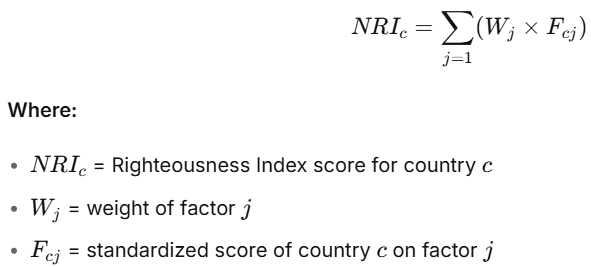
The Righteousness Index for Nations is calculated using the following formula:
Score Normalization
Because different indices use different measurement scales, all raw data must first be standardized. We apply min-max normalization to convert all scores to a 0–1 scale:
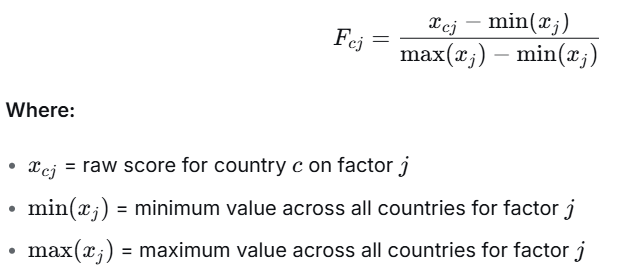
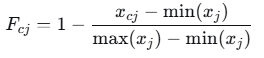
For factors where a higher raw score indicates worse performance (such as crime rate), we apply an inverted normalization:
Weighting Structure
Following established methodologies in composite index construction (OECD, 2008; Nardo et al., 2005), we assign weights to each dimension based on their relative importance to national righteousness:
| Dimension | Weight |
|---|---|
| Anti-Corruption | 0.20 |
| Human Rights | 0.20 |
| Public Safety | 0.15 |
| Freedom | 0.15 |
| Rule of Law | 0.15 |
| National Responsibility | 0.15 |
| Total | 1.00 |
These weights are applied consistently across all countries to ensure comparability.
Our Methodology
The Righteousness Index for Nations is constructed through a transparent, replicable process:
Step 1: Data Collection
We gather the most recent publicly available data from respected global sources, including Transparency International, the V-Dem Institute, the World Justice Project, the Cato Institute, and the World Intellectual Foundation.
Step 2: Normalization
All data is converted to a standardized 0–1 scale using the formulas above, ensuring that each dimension contributes fairly to the final score.
Step 3: Aggregation
Scores are combined using the weighted formula:

Where each variable represents the normalized score for that country on the respective dimension.
Step 4: Ranking
Countries are ranked from highest to lowest, revealing which nations lead in moral governance—and which have work to do.
Data Sources
The Righteousness Index for Nations is built on transparent, publicly available data from respected global institutions. We gratefully acknowledge the work of these organizations in measuring and publishing indicators that make our index possible.
| Dimension | Primary Data Source | Latest Data |
|---|---|---|
| Anti-Corruption | Transparency International — Corruption Perceptions Index (CPI) (Transparency International, 2026) | 2026 |
| Human Rights | V-Dem Institute — Human Rights Index (Coppedge et al., 2025) | 2025 |
| Public Safety | Numbeo / World Population Review — Crime Index (Numbeo, 2026) | 2026 |
| Freedom | Cato Institute / Fraser Institute — Human Freedom Index (Vásquez & Porčnik, 2025) | 2025 |
| Rule of Law | World Justice Project — Rule of Law Index (World Justice Project, 2026) | 2026 |
| National Responsibility | World Intellectual Foundation — Responsible Nations Index (World Intellectual Foundation, 2026) | 2026 |
All raw data is publicly accessible through the respective organizations’ websites. The Righteousness Index applies normalization and weighting as described in our Methodology section.
Example Calculation
To illustrate how the formula works, consider a hypothetical country with the following normalized scores:
| Dimension | Normalized Score (0-1) | Weight | Contribution |
|---|---|---|---|
| Anti-Corruption | 0.85 | 0.20 | 0.170 |
| Human Rights | 0.90 | 0.20 | 0.180 |
| Public Safety | 0.75 | 0.15 | 0.113 |
| Freedom | 0.80 | 0.15 | 0.120 |
| Rule of Law | 0.70 | 0.15 | 0.105 |
| National Responsibility | 0.60 | 0.15 | 0.090 |
| Total NRI Score | 0.778 |
This country would rank among the higher-scoring nations, reflecting strong performance across most dimensions.
A Living Index
The Righteousness Index for Nations is updated annually. As new data becomes available, we track not only where nations stand, but where they are going.
Is a nation rising in righteousness—or declining?
Is it acknowledging past wrongs—and correcting them?
These questions matter. The answers shape our world.
A Note on Humility
No index can fully capture the soul of a nation. Data has limitations. Cultures differ. History runs deep. As scholars have long noted, quantifying complex social phenomena requires both rigor and humility (Ravallion, 2012).
We offer the Righteousness Index not as a final judgment, but as an invitation to reflection—for citizens, for leaders, and for all who believe that nations, like individuals, should be measured not only by their power, but by their righteousness.
References
Coppedge, M., Gerring, J., Knutsen, C. H., Lindberg, S. I., Teorell, J., et al. (2025). V-Dem [Country-Year/Country-Date] Dataset v15. Varieties of Democracy (V-Dem) Project. https://www.v-dem.net
Nardo, M., Saisana, M., Saltelli, A., Tarantola, S., Hoffman, A., & Giovannini, E. (2005). Handbook on Constructing Composite Indicators: Methodology and User Guide. OECD Publishing.
Numbeo. (2026). Crime Index by Country 2026. Numbeo / World Population Review. https://www.numbeo.com/crime/rankings_by_country.jsp
OECD. (2008). Handbook on Constructing Composite Indicators: Methodology and User Guide. OECD Publications.
Ravallion, M. (2012). Mashup Indices of Development. The World Bank Policy Research Working Paper No. 5432.
Stiglitz, J. E., Sen, A., & Fitoussi, J. P. (2009). Report by the Commission on the Measurement of Economic Performance and Social Progress. https://ec.europa.eu/eurostat/documents/8131721/8131772/Stiglitz-Sen-Fitoussi-Commission-report.pdf
Transparency International. (2026). Corruption Perceptions Index 2026. Transparency International. https://www.transparency.org
Vásquez, I., & Porčnik, T. (2025). The Human Freedom Index 2025. Cato Institute / Fraser Institute. https://www.cato.org/human-freedom-index
World Intellectual Foundation. (2026). Responsible Nations Index 2026. World Intellectual Foundation.
World Justice Project. (2026). Rule of Law Index 2026. World Justice Project. https://worldjusticeproject.org