Yes. Since your RI framework is hierarchical, the questionnaire should follow the same tree structure and use multi-item Likert scales (commonly 1–5 or 1–7) so you can later test reliability (Cronbach’s α) and validity (EFA/CFA).
Recommended scale:
1 = Strongly Disagree
2 = Disagree
3 = Neutral
4 = Agree
5 = Strongly Agree
Righteousness Index (RI) Questionnaire for Business Organizations
Section A. Internal Righteousness (IR)
A1. Leadership Integrity
- Senior leadership demonstrates honesty in decision-making.
- The CEO acts consistently with stated organizational values.
- Top management admits mistakes when errors occur.
- Leaders avoid deceptive or misleading practices.
A2. Ethical Culture
- Employees feel encouraged to speak truthfully.
- Ethical behavior is valued in daily work.
- Employees trust organizational leadership.
- Ethical concerns can be openly discussed.
A3. Governance Fairness
- Decision-making processes are fair.
- Organizational policies are applied consistently.
- Conflicts of interest are properly managed.
- Leadership is held accountable for misconduct.
A4. Whistleblower Protection
- Employees can report wrongdoing safely.
- Retaliation against whistleblowers is prohibited.
- Reported ethical issues are taken seriously.
A5. Board Independence
- Independent directors provide meaningful oversight.
- The board challenges management when necessary.
- Governance decisions are free from undue influence.
Section B. External Righteousness (ER)
B1. Customer Righteousness
- Products/services are delivered honestly.
- Advertising is truthful.
- Customers are treated fairly.
- Complaints are resolved responsibly.
B2. Employee Righteousness
- Employees receive fair compensation.
- Employees are treated with dignity and respect.
- Workplace safety is prioritized.
- Discrimination is actively prevented.
B3. Supply Chain Righteousness
- Suppliers are treated fairly.
- The organization avoids exploitative sourcing.
- Supplier ethics are monitored regularly.
- Forced labor and child labor are prohibited.
B4. Investor Righteousness
- Financial reporting is transparent.
- Investors receive accurate information.
- The organization avoids misleading disclosures.
- Long-term value is prioritized over short-term manipulation.
B5. Social Responsibility
- The organization contributes positively to society.
- Environmental responsibilities are taken seriously.
- Community interests are considered.
- The company avoids causing unnecessary social harm.
Section C. Accountability for Wrongdoing (AW)
C1. Litigation History
- The organization has a low history of serious lawsuits.*
- Legal disputes are handled responsibly.
(*reverse-coded if needed)
C2. Regulatory Violations
- The organization complies with regulations.
- Regulatory violations are rare.
- Compliance failures are corrected quickly.
C3. Public Apology
- The organization publicly acknowledges mistakes.
- Leadership communicates transparently after failures.
C4. Corrective Action
- Corrective actions are implemented promptly.
- Root causes of misconduct are addressed.
- Systems are improved after failures.
C5. Repentance & Restoration
- The organization demonstrates genuine remorse after wrongdoing.
- Harmed stakeholders are fairly compensated.
- The organization learns from past mistakes.
Demographic / Organization Information
- Industry type: __________
- Organization size: __________
- Respondent role: __________
- Years with organization: __________
- Country: __________
Scoring Model
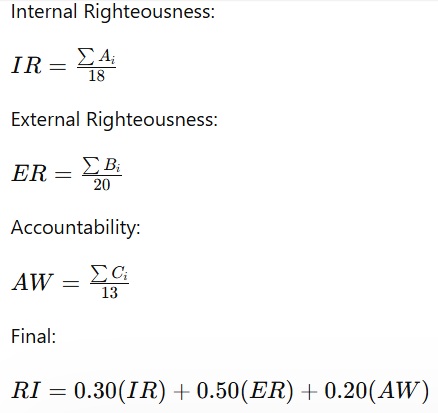
Research design recommendation
Use 3 respondent groups for stronger validity:
- Internal respondents
- employees
- managers
- directors
- External respondents
- customers
- suppliers
- investors
- Objective data
- lawsuits
- regulator penalties
- public records