
14.1 Toward Measurable AI Righteousness
14.2 AI Governance Research Opportunities
14.3 Education and Professional Development
14.4 RAGF Certification and Professional Community
14.5 Toward a Global Righteous AI Ecosystem
Part IV — RAGF Implementation and Ecosystem
14. Future Vision of RAGF
The Righteous AI Governance Framework (RAGF) represents a significant step toward integrating measurable righteousness into AI governance. However, it is not the final destination. This chapter outlines the future vision for RAGF—where it can lead, what opportunities it creates, and how it can contribute to a global ecosystem of righteous AI.
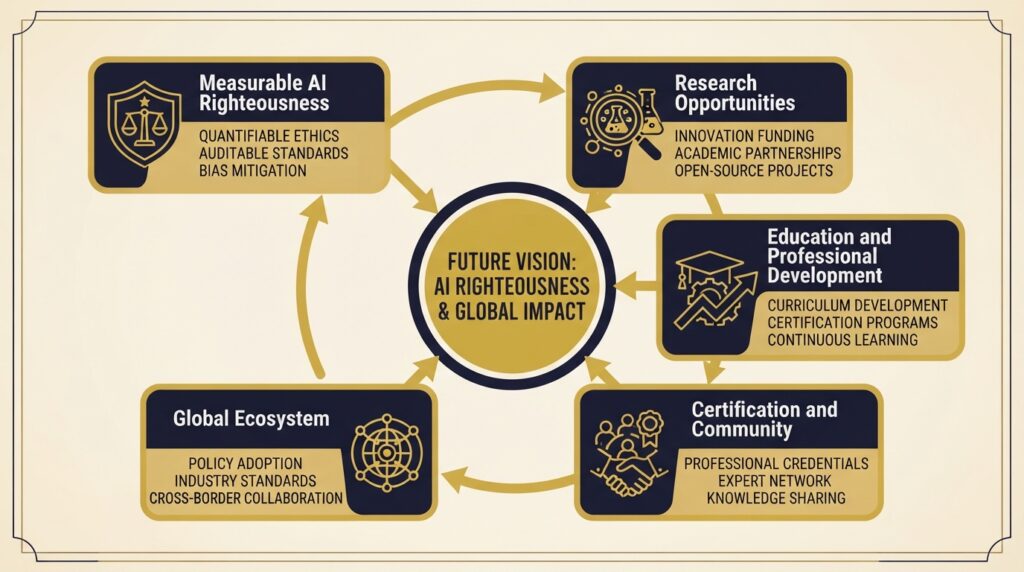
Figure 1 — RAGF Future Vision: The Road Ahead
This figure illustrates the five pillars of the RAGF future vision — Measurable AI Righteousness, Research Opportunities, Education and Professional Development, Certification and Community, and Global Ecosystem — showing how they interconnect to build a righteous AI future.
14.1 Toward Measurable AI Righteousness
The most fundamental contribution of RAGF is the transformation of righteousness from an abstract moral ideal into a measurable, auditable, and improvable governance capability. This section outlines the future development of this measurement system.
The Evolution of RI and RGS
The Righteousness Index (RI) and Righteousness Growth Score (RGS) are currently in their initial form. Future development will focus on:
Table 1 — RI and RGS Future Development
| Development Area | Description | Timeline |
|---|---|---|
| RI Refinement | Improve measurement accuracy and reliability | 1-2 years |
| Sector-Specific RI | Develop tailored RI variants for healthcare, finance, education, and other sectors, including user-specific (RI‑U) variants | 2-3 years |
| Real-Time RI | Enable continuous, real-time righteousness measurement | 3-5 years |
| Automated RI | Develop automated assessment tools | 2-4 years |
| RI Benchmarking | Establish industry benchmarks and comparative data | 2-3 years |
This table outlines the planned future development areas for the Righteousness Index (RI) and Righteousness Growth Score (RGS), including descriptions and estimated timelines.
The Vision: AI Righteousness as a Standard Metric
The long-term vision is for AI righteousness to become a standard metric—as common and expected as safety ratings, carbon footprints, or financial credit scores. In this vision:
Table 2 — The Vision: AI Righteousness as a Standard Metric
| Application | Description |
|---|---|
| Pre-Deployment | Organizations check an AI system’s RI before deployment |
| Procurement | RI scores inform purchasing decisions |
| Oversight | Regulators monitor RI trends across industries |
| Public Trust | Consumers use RI scores to make informed choices |
Key Insight: As RI becomes a standard metric, righteousness transitions from a voluntary aspiration to an expected, transparent, and accountable dimension of AI governance (Floridi et al., 2018; Smuha, 2021).
This table describes the long-term vision for AI righteousness as a standard metric across four applications — pre-deployment, procurement, oversight, and public trust.
Table 3 — The Vision: AI Righteousness as a Standard Metric
| Application | Description |
|---|---|
| Pre-Deployment | Organizations check an AI system’s RI before deployment |
| Procurement | RI scores inform purchasing decisions |
| Oversight | Regulators monitor RI trends across industries |
| Public Trust | Consumers use RI scores to make informed choices |
14.2 AI Governance Research Opportunities
RAGF opens numerous research opportunities across multiple disciplines. This section identifies key research areas that can advance the theory and practice of righteous AI governance.
Research Areas
This table identifies key research opportunities across multiple disciplines — measurement, verification, standards, cross-cultural, and implementation — with descriptions and potential research questions.
Table 4 — AI Governance Research Opportunities
| Research Area | Description | Potential Research Questions |
|---|---|---|
| Measurement Science | Improving RI measurement accuracy and validity | How can we better quantify righteousness? What are the limits of measurement? |
| Verification Methods | Ensuring RI scores are reliable and not gamed | Can RI scores be gamed? How do we verify authenticity? |
| Standards Development | Integrating righteousness into formal standards | How should RAGF be incorporated into NIST, ISO, and other standards? |
| Cross-Cultural Studies | Understanding righteousness across cultures | Does righteousness mean the same thing in different cultural contexts? |
| Implementation Research | Studying how organizations adopt RAGF | What factors enable or inhibit adoption? What are best practices? |
| Longitudinal Studies | Tracking righteousness growth over time | What patterns emerge? What drives sustained improvement? |
Interdisciplinary Collaboration
RAGF research benefits from collaboration across disciplines:
Table 5 — Interdisciplinary Contributions to AI Governance Research
| Discipline | Contribution |
|---|---|
| Computer Science | Automated assessment, monitoring tools, algorithm fairness |
| Ethics and Philosophy | Normative foundations, moral reasoning, virtue ethics |
| Law | Regulatory alignment, liability frameworks, compliance |
| Organizational Studies | Governance structures, adoption patterns, cultural change |
| Psychology | Behavioral drivers of righteousness, motivation |
| Economics | Incentives, cost-benefit analysis, market effects |
Research Agenda
This table outlines the research agenda for RAGF across three phases — short-term, mid-term, and long-term — with key research questions and intended outcomes.
Table 6 — RAGF Research Agenda
| Phase | Focus | Key Research Questions | Intended Outcome |
|---|---|---|---|
| Short-Term | Validation and refinement | How reliable is RI? What refinements are needed? | Validated measurement tools |
| Mid-Term | Standards and integration | How can RAGF be incorporated into formal standards? | Standards proposals |
| Long-Term | Global ecosystem | How can RAGF contribute to global AI governance? | Global framework |
14.3 Education and Professional Development
For RAGF to achieve widespread adoption, education and professional development are essential. This section outlines the vision for building capability in righteous AI governance.
Education Pillars
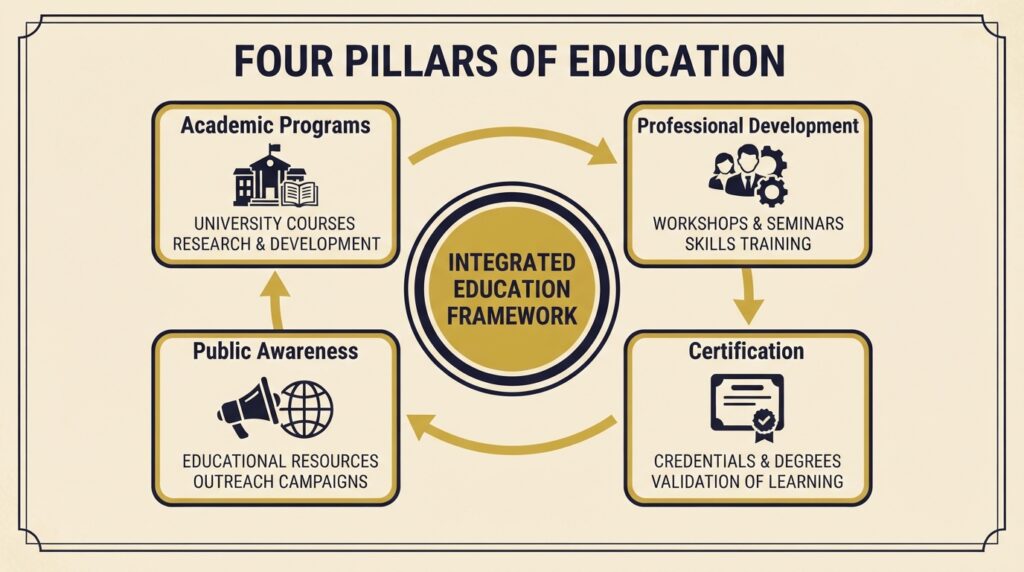
Figure 2 — RAGF Education Ecosystem
This figure illustrates the four pillars of the RAGF education ecosystem — Academic Programs, Professional Development, Public Awareness, and Certification — showing how they work together to build capability in righteous AI governance.
This table outlines the four pillars of the RAGF education ecosystem — Academic Programs, Professional Development, Public Awareness, and Certification — with descriptions and target audiences.
Table 7 — RAGF Education Ecosystem
| Pillar | Description | Target Audience |
|---|---|---|
| Academic Programs | University courses, research programs, degrees | Students, researchers |
| Professional Development | Workshops, training programs, executive education | Practitioners, leaders |
| Public Awareness | Resources, outreach, public education | General public, policymakers |
| Certification | RAGF Practitioner, RAGF Auditor, RAGF Leader | Professionals |
Curriculum Development
This table outlines the key curriculum areas for RAGF education — Framework Fundamentals, Measurement and Assessment, Governance Implementation, and Advanced Topics — with descriptions and target learners.
Table 8 — RAGF Curriculum Areas
| Curriculum Area | Description | Target Learner |
|---|---|---|
| Framework Fundamentals | RAGF overview, Five Pillars, Seven Layers | All levels |
| Measurement and Assessment | RI, RGS, RDM, RPS methodology | Practitioners |
| Governance Implementation | Implementing RAGF in organizations | Leaders, managers |
| Advanced Topics | AI ethics, law, policy, and emerging challenges | Advanced practitioners |
14.4 RAGF Certification and Professional Community
Certification and professional community development are essential for establishing RAGF as a recognized standard and building a community of practitioners committed to righteous AI governance.
Certification Program
This table outlines the three levels of the RAGF certification program — RAGF Practitioner, RAGF Auditor, and RAGF Leader — including their focus and certification requirements.
Table 9 — RAGF Certification Program
| Certification Level | Focus | Requirements |
|---|---|---|
| RAGF Practitioner | Foundational knowledge and application | Training + exam |
| RAGF Auditor | Assessment and verification | Practitioner + audit training + experience |
| RAGF Leader | Governance and organizational leadership | Auditor + leadership experience + case study |
Professional Community
This table outlines the key components of professional community development for RAGF — conferences, working groups, publications, and online community — with descriptions and target participants.
Table 10 — Professional Community Development
| Component | Description | Target Participants |
|---|---|---|
| Conferences | Annual RAGF conferences and workshops | All practitioners |
| Working Groups | Collaborative research and standard development | Researchers, practitioners |
| Publications | Journals, white papers, case studies | Researchers, practitioners |
| Online Community | Forums, webinars, knowledge sharing | All practitioners |
14.5 Toward a Global Righteous AI Ecosystem
The ultimate vision for RAGF is to contribute to a global ecosystem of righteous AI governance—where righteousness is embedded in AI development, deployment, and oversight worldwide.
Ecosystem Components
This table outlines the key components of a global righteous AI ecosystem — standards, regulation, industry, academia, and civil society — with their roles and contributions.
Table 11 — Global Righteous AI Ecosystem
| Component | Role | Contribution |
|---|---|---|
| Standards Organizations | Develop and maintain standards | NIST, ISO, IEEE incorporation of righteousness |
| Regulators | Enforce and incentivize righteousness | EU AI Act, national regulations |
| Industry | Adopt and implement RAGF | Best practices, case studies, innovation |
| Academia | Research and education | Evidence base, new methods, trained professionals |
| Civil Society | Advocacy and accountability | Public awareness, oversight, trust |
The Global Vision
The long-term vision for RAGF is:
Table 12 — The Global Vision for RAGF
| Element | Vision |
|---|---|
| Adoption | Widespread adoption across sectors and regions |
| Recognition | Recognized as a standard for AI righteousness |
| Integration | Integrated into formal standards and regulations |
| Community | Vibrant community of practitioners and researchers |
| Impact | Demonstrable improvement in AI righteousness worldwide |
Key Insight: A global righteous AI ecosystem is not a luxury—it is a necessity for ensuring that AI serves humanity with integrity, justice, wisdom, stewardship, and beneficence.
References
Dignum, V. (2019). Responsible artificial intelligence: How to develop and use AI in a responsible way. Springer.
European Parliament. (2024). Regulation (EU) 2024/1689 of the European Parliament and of the Council of 13 June 2024 laying down harmonised rules on artificial intelligence (Artificial Intelligence Act). Official Journal of the European Union.
Floridi, L., & Cowls, J. (2019). A unified framework of five principles for AI in society. Harvard Data Science Review, 1(1).
Floridi, L., Cowls, J., Beltrametti, M., Chatila, R., Chazerand, P., Dignum, V., … & Vayena, E. (2018). AI4People—An ethical framework for a good AI society: Opportunities, risks, principles, and recommendations. Minds and Machines, 28(4), 689–707.
Jobin, A., Ienca, M., & Vayena, E. (2019). The global landscape of AI ethics guidelines. Nature Machine Intelligence, 1(9), 389–399.
National Institute of Standards and Technology. (2023). Artificial Intelligence Risk Management Framework (AI RMF 1.0). U.S. Department of Commerce. https://doi.org/10.6028/NIST.AI.100-1
OECD. (2019). OECD Principles on Artificial Intelligence. OECD Publishing.
Russell, S. (2019). Human compatible: Artificial intelligence and the problem of control. Viking.
Smuha, N. A. (2021). From a ‘race to the bottom’ to a ‘race to the top’? The regulation of AI and the EU AI Act. European Journal of Legal Studies, 13(2), 45–72.