
The Righteousness Multiplier
A Method for Measuring Moral Growth and Transformation Across Time
Introduction
The Righteousness Index provides a framework for measuring moral character. It answers the question: “How righteous is a person’s character and behavior at this moment?”
But righteousness is not static. It lives and breathes across time. Human beings are not photographs—we are stories unfolding.
This article presents The Righteousness Multiplier, a method designed to capture not just where a person stands, but where they are going.
The Limitation of a Single Moment
Consider two individuals:
| Person | G (Good) | B (Bad) | A (Acknowledgment) | C (Correction) | Score |
|---|---|---|---|---|---|
| Adam | 50 | 10 | 0 | 0 | 40 |
| Elena | 30 | 20 | 1 | 1 | 22 |
By a simple snapshot, Adam appears more righteous.
But now add the dimension of time:
| Person | Score 5 Years Ago | Score Today | Trajectory |
|---|---|---|---|
| Adam | 40 | 40 | → Flat (Stagnant) |
| Elena | -10 | 22 | ↗ Rising (Transformed) |
The snapshot misses everything that matters.
Elena was once lost. Now she is found. Adam never strayed—but never grew.
Who is more righteous today? The Multiplier, viewed through time, invites us to reconsider.
The Righteousness Multiplier Formula
Understanding the Components
| Symbol | Meaning |
|---|---|
| G | Acts of moral courage, honesty, kindness, and ethical choices |
| B | Wrongs committed, harm caused, moments of moral failure |
| A | Owning mistakes, sincere regret, confessing the wrong |
| C | Making amends, changing behavior, genuine transformation |
How the Multiplier Works
| Component | Effect |
|---|---|
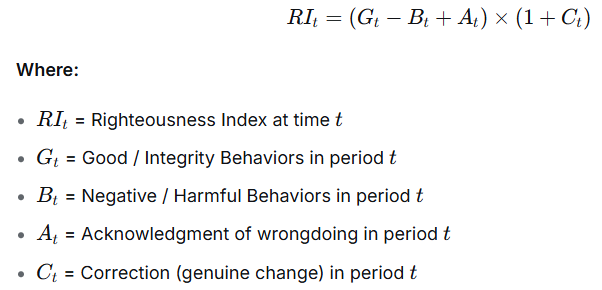
| G – B | Your net moral balance — the good minus the harm in this period |
| + A | Acknowledgment adds to your score because owning the wrong is the first step toward righteousness |
| ×(1 + C) | Correction is the multiplier. If you truly change and make things right, your entire score is multiplied. |
- If C = 0 (no correction), the score stands as is.
- If C = 1 (genuine correction), the score is doubled.
Why a Multiplier?
Because correction changes everything—and its effects compound.
Acknowledgment says: “I was wrong.”
Correction says: “I am becoming right.”
And over time, becoming right creates momentum. Each act of integrity makes the next act easier. Each moment of moral courage strengthens the next.
The Multiplier honors the profound truth that a changed heart is worth more than a lifetime of empty ritual—and that change, once real, builds upon itself.
Dynamic Concepts Across Time
| Concept | Meaning |
|---|---|
| RIₜ | Righteousness score at a specific time |
| ΔRI | Change in righteousness between periods |
| Growth Rate | (RIₜ – RIₜ₋₁) / RIₜ₋₁ |
| Momentum | Acceleration or deceleration of moral growth |
| Inflection Point | The moment genuine change began |
Real-Life Examples Across Time
Example 1: The Quiet Life (Flat Trajectory)
A person lives decently but never grows:
| Year | G | B | A | C | RI |
|---|---|---|---|---|---|
| 1 | 10 | 0 | 0 | 0 | 10 |
| 2 | 10 | 0 | 0 | 0 | 10 |
| 3 | 10 | 0 | 0 | 0 | 10 |
| 4 | 10 | 0 | 0 | 0 | 10 |
| 5 | 10 | 0 | 0 | 0 | 10 |
Trajectory: Flat. No growth. No decline. No transformation.
Example 2: The Honest Growth (Rising Trajectory)
A person makes mistakes, owns them, and changes:
| Year | G | B | A | C | RI |
|---|---|---|---|---|---|
| 1 | 5 | 10 | 0 | 0 | -5 |
| 2 | 6 | 8 | 1 | 0 | -1 |
| 3 | 8 | 4 | 1 | 1 | (8-4+1)×2 = 10 |
| 4 | 12 | 2 | 1 | 1 | (12-2+1)×2 = 22 |
| 5 | 15 | 1 | 1 | 1 | (15-1+1)×2 = 30 |
Trajectory: Rising. The inflection point at Year 3 changed everything.
Example 3: The Late Bloomer (Compounding Grace)
A person lived poorly but had a late-life transformation:
| Year | G | B | A | C | RI |
|---|---|---|---|---|---|
| 1-20 | 2 avg | 15 avg | 0 | 0 | -13 avg |
| 21 | 5 | 2 | 1 | 1 | (5-2+1)×2 = 8 |
| 22 | 10 | 1 | 1 | 1 | (10-1+1)×2 = 20 |
| 23 | 15 | 0 | 1 | 1 | (15-0+1)×2 = 32 |
| 24 | 20 | 0 | 1 | 1 | (20-0+1)×2 = 42 |
By Year 24, his righteousness exceeds those who never stumbled but never grew. Compounding transformation has outpaced static comfort.
Visualizing the Dynamic Multiplier
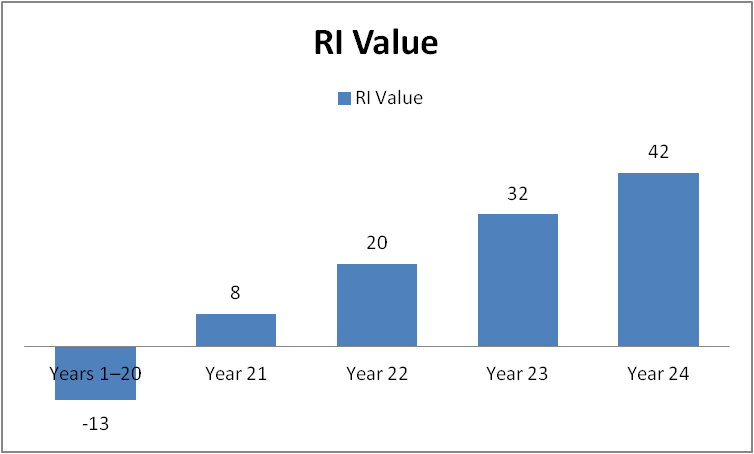
The inflection point at Year 21 changes everything. What follows is not just recovery—it is compounding moral growth.
The Story That Illuminates the Multiplier
Two criminals were crucified beside Jesus. One mocked Him. The other rebuked the mocker, admitted his own guilt, and said, “Jesus, remember me when you come into your kingdom.” Jesus replied: “Today you will be with me in paradise.”— Luke 23:39–43
The thief on the cross had:
- Few good deeds (G was small)
- A lifetime of wrong (B was great)
- Sincere acknowledgment (A = 1 at time of death)
- One act of moral courage (C = 1 at time of death)
His time was short. But if we could project his trajectory forward:
| Time Period | G | B | A | C | RI |
|---|---|---|---|---|---|
| Lifetime Before | 5 | 50 | 0 | 0 | -45 |
| Final Hours | 1 | 0 | 1 | 1 | (1 – 0 + 1) × 2 = 4 |
| If He Had Lived -Projected | 10/year | 0 | Ongoing | Ongoing | Compounding growth |
His final hours created an inflection point. Had he lived, his righteousness would have compounded.
The story tells us what the numbers alone cannot fully capture: grace meets us at our inflection point.
Key Insights
| Insight | Meaning |
|---|---|
| Inflection Points Matter | One moment of genuine change can alter an entire lifetime trajectory |
| Compounding is Real | Each act of integrity makes the next easier and more likely |
| Past Weight Lingers | Even with transformation, past harm may take time to overcome |
| Trajectory > Snapshot | Where someone is going matters more than where they have been |
| Grace Transcends Math | Some transformations cannot be fully captured by numbers |
Questions the Multiplier Asks
- Where was I five years ago? Where am I today?
- Is my trajectory flat, rising, or falling?
- Have I had an inflection point—a moment of genuine change?
- Am I compounding righteousness, or just maintaining?
- If my past is heavy, am I open to grace?
A Final Reflection
The Righteousness Multiplier does not claim to be the final word on human worth. It is a tool—a mirror—an invitation to look not only at where we stand, but where we are going.
It asks us to consider:
Am I the same person I was yesterday?
Have I owned my failures?
Have I truly changed?
Is my trajectory rising?
And if my past still weighs heavily, is there room for grace?
The thief on the cross had no time to build a resume of good deeds. But in one moment of genuine acknowledgment and moral courage, he created an inflection point that eternity itself recognized.
The Multiplier reminds us: It is never too late to change. And change, once real, compounds forever.