
10.1 Beginning the RAGF Journey
10.2 Baseline Assessment
10.3 Governance Design
10.4 Monitoring and Measurement
10.5 Continuous Improvement
10.6 Plan Correction: From Diagnosis to Action
10.7 Practical Reinforcement: Education, Reflection, and Continuous Practice
Part IV — RAGF Implementation and Ecosystem
Chapter 10: RAGF Implementation Guide
10.1 Beginning the RAGF Journey
Implementing the Righteous AI Governance Framework (RAGF) is not a one-time project but a strategic transformation of how an organization governs AI. The journey begins with a clear understanding of three foundational questions:
Table 1 — Foundational Questions for the RAGF Journey
| Question | Purpose |
|---|---|
| Why are we adopting RAGF? | Clarify the motivation — risk reduction, competitive advantage, ethical commitment, or regulatory readiness |
| Where are we now? | Assess the current state of AI governance against RAGF standards |
| Where do we want to go? | Define the target state and prioritize the most critical gaps |
Organizational Readiness
Before beginning the RAGF journey, organizations should assess their readiness across five dimensions:
Table 2 — Organizational Readiness Dimensions
| Readiness Dimension | Key Questions |
|---|---|
| Leadership Commitment | Is executive leadership visibly committed to righteous AI governance? |
| Resource Availability | Are adequate resources (budget, personnel, tools) allocated? |
| Organizational Culture | Does the culture support ethical reflection and continuous improvement? |
| Technical Capability | Does the organization have the technical expertise to implement RAGF? |
| Stakeholder Alignment | Are key stakeholders (legal, compliance, engineering, business) aligned? |
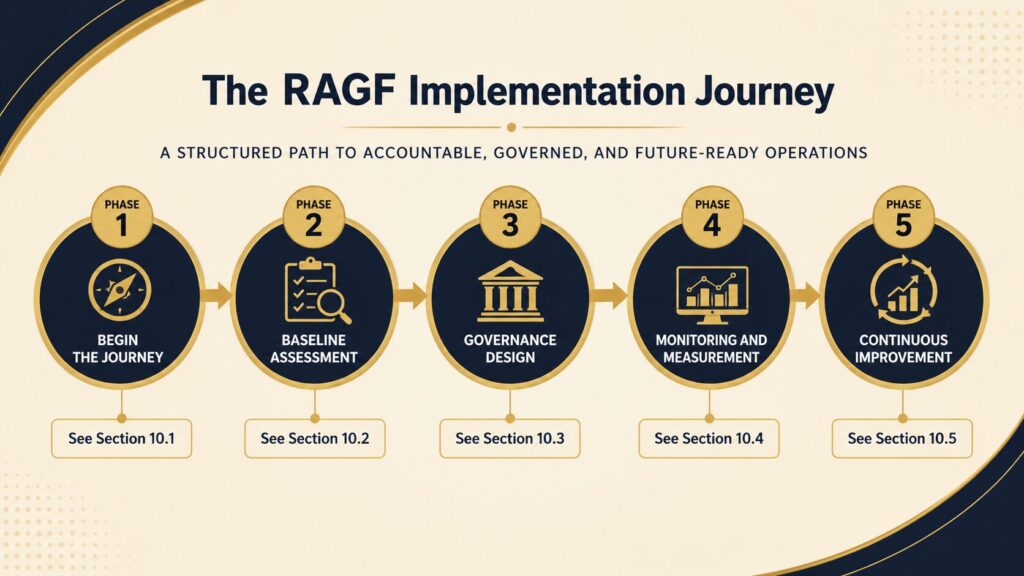
Figure 1 — The RAGF Journey Map
This figure illustrates the five-phase RAGF implementation journey — Begin the Journey, Baseline Assessment, Governance Design, Monitoring and Measurement, and Continuous Improvement — showing how organizations progress from initial adoption to sustained righteousness governance.
Key Insight: The RAGF journey is iterative, not linear. Organizations may cycle through phases multiple times as they mature in their righteousness governance capabilities (Kotter, 2012).
10.2 Baseline Assessment
The baseline assessment establishes the current state of AI righteousness within the organization. It provides the foundation for all subsequent governance activities.
Purpose of the Baseline Assessment
Table 3 — Purpose of the Baseline Assessment
| Purpose | Description |
|---|---|
| Establish Starting Point | Document the current state of AI governance practices |
| Identify Gaps | Identify where practices fall short of RAGF standards |
| Create Visibility | Build awareness of AI governance strengths and weaknesses |
| Inform Prioritization | Guide resource allocation toward the most critical gaps |
Assessment Scope
The baseline assessment should cover four key areas:
Table 4 — Baseline Assessment Scope
| Assessment Area | Focus | Method |
|---|---|---|
| AI Inventory | What AI systems exist? What are their functions and risks? | System inventory, interviews, documentation review |
| Development Practices | How are AI systems developed? Are righteousness principles embedded? | Code reviews, process audits, developer interviews |
| Organizational Governance | What policies, structures, and oversight mechanisms exist? | Policy review, governance structure assessment |
| Cultural Factors | Does the organizational culture support righteous AI? | Surveys, interviews, cultural assessment |
Conducting the Assessment
Table 5 — Baseline Assessment Process
| Step | Activity | Output |
|---|---|---|
| 1 | Define Assessment Scope | Identify which AI systems, teams, and organizational units to assess |
| 2 | Gather Evidence | Collect data through interviews, documentation review, and technical analysis |
| 3 | Evaluate Against RAGF Standards | Score each dimension against the Five Pillars and Seven Layers |
| 4 | Identify Gaps | Compare current state to target state |
| 5 | Document Findings | Create a baseline assessment report |
Baseline Assessment Outputs
Table 6 — Baseline Assessment Outputs
| Output | Description |
|---|---|
| Current RI Scores | RI-D, RI-P, RI-O, RI-U scores for the organization |
| Pillar-Level Breakdowns | Scores for Integrity, Justice, Stewardship, Wisdom, Beneficence |
| Gap Analysis | Identification of specific gaps and weaknesses |
| Risk Assessment | Prioritized list of righteousness risks |
| Recommendations | High-level recommendations for improvement |
Key Insight: The baseline assessment transforms abstract concerns about AI righteousness into concrete, measurable data that can guide decision-making (Smuha, 2021).
10.3 Governance Design
Based on the baseline assessment findings, organizations must design or refine their AI governance structures, policies, and processes.
Governance Design Principles
Table 7 — Governance Design Principles
| Principle | Description |
|---|---|
| Proportionality | Governance should be proportional to the risks posed by AI systems |
| Integration | Governance should be integrated into existing organizational structures, not separate |
| Clarity | Roles, responsibilities, and accountabilities should be clearly defined |
| Flexibility | Governance should adapt to evolving technologies and circumstances |
| Inclusivity | Diverse perspectives should be included in governance design |
Governance Design Elements
This table outlines the five key elements of AI governance design — governance structure, policies, processes, controls, and metrics — with their descriptions and key activities.
Table 8 — Governance Design Elements
| Element | Description | Key Activities |
|---|---|---|
| Governance Structure | The organizational framework for AI oversight | Define roles, responsibilities, decision-making authorities |
| Policies | Formal rules and guidelines for AI governance | Draft, review, approve, and communicate AI policies |
| Processes | Procedures for implementing governance policies | Document workflows, assign owners, establish timelines |
| Controls | Safeguards to prevent and detect violations | Implement technical and administrative controls |
| Metrics | Measures to track governance effectiveness | Define KPIs, establish monitoring, create reporting |
Governance Structure Options
Table 9 — Governance Structure Options
| Structure Type | Description | Best For |
|---|---|---|
| Centralized | Single governance body oversees all AI activities | Organizations with centralized AI strategy |
| Decentralized | Each business unit governs its own AI | Organizations with diverse, independent AI use cases |
| Federated | Central oversight with distributed execution | Large organizations with both centralized and local needs |
Policy Areas to Address
Table 10 — Policy Areas to Address
| Policy Area | Description | Priority |
|---|---|---|
| Data Governance | How data is collected, used, and protected | High |
| Algorithmic Fairness | How bias is detected and mitigated | High |
| Transparency and Explainability | How AI decisions are explained | Medium |
| Human Oversight | How humans supervise AI systems | High |
| Incident Response | How AI incidents are managed | Medium |
| Vendor Management | How third-party AI is governed | Medium |
Key Insight: Governance design is not a one-time activity. It must be reviewed and updated as the organization’s AI capabilities and risks evolve (Dignum, 2019).
10.4 Monitoring and Measurement
Once governance structures are in place, organizations must implement continuous monitoring and measurement to ensure ongoing righteousness.
Monitoring Purpose
Table 11 — Purpose of Monitoring
| Purpose | Description |
|---|---|
| Detect Drift | Identify when AI behavior deviates from righteousness standards |
| Verify Compliance | Confirm that governance policies are being followed |
| Identify Emerging Risks | Detect new risks before they materialize |
| Inform Decisions | Provide data for governance decisions |
| Demonstrate Accountability | Provide evidence of governance effectiveness |
Monitoring Dimensions
This table outlines the four key monitoring dimensions for RAGF implementation — technical monitoring, behavioral monitoring, governance monitoring, and performance monitoring — with their descriptions and metrics.
Table 12 — RAGF Monitoring Dimensions
| Dimension | Description | Key Metrics |
|---|---|---|
| Technical Monitoring | Monitor AI system performance and behavior | Accuracy, bias metrics, error rates, system logs |
| Behavioral Monitoring | Monitor AI agent decisions and actions | Decision quality, compliance with boundaries, anomalous behavior |
| Governance Monitoring | Monitor governance policy adherence | Policy compliance rates, audit findings, incident counts |
| Performance Monitoring | Monitor overall governance effectiveness | RI scores, RGS trends, stakeholder satisfaction |
Monitoring Implementation
Table 13 — Monitoring Implementation Steps
| Step | Activity | Output |
|---|---|---|
| 1 | Define Monitoring Requirements | Specify what to monitor, how often, and by whom |
| 2 | Implement Monitoring Tools | Deploy technical and process monitoring capabilities |
| 3 | Collect Data | Gather monitoring data on an ongoing basis |
| 4 | Analyze Data | Identify patterns, anomalies, and trends |
| 5 | Report Findings | Communicate monitoring results to stakeholders |
Measurement Framework
The RAGF measurement system provides quantitative metrics for tracking AI righteousness:
Table 14 — RAGF Measurement Framework
| Metric | Focus | Frequency |
|---|---|---|
| RI (Righteousness Index) | Current state of AI righteousness | Annual or semi-annual |
| RGS (Righteousness Growth Score) | Improvement over time | After each RI assessment |
| RDM (Righteousness Decision Metric) | Individual decision righteousness | Continuous |
| RPS (Righteousness Performance Score) | Governance effectiveness | Quarterly |
Key Insight: Monitoring transforms righteousness from an abstract aspiration into a managed, measurable process. Organizations that monitor systematically are better positioned to sustain and accelerate their growth (National Institute of Standards and Technology, 2023).
10.5 Continuous Improvement
Continuous improvement is the engine that sustains and advances AI righteousness over time. It ensures that governance practices evolve with changing technologies, regulations, and societal expectations.
RAGF Continuous Improvement Cycle
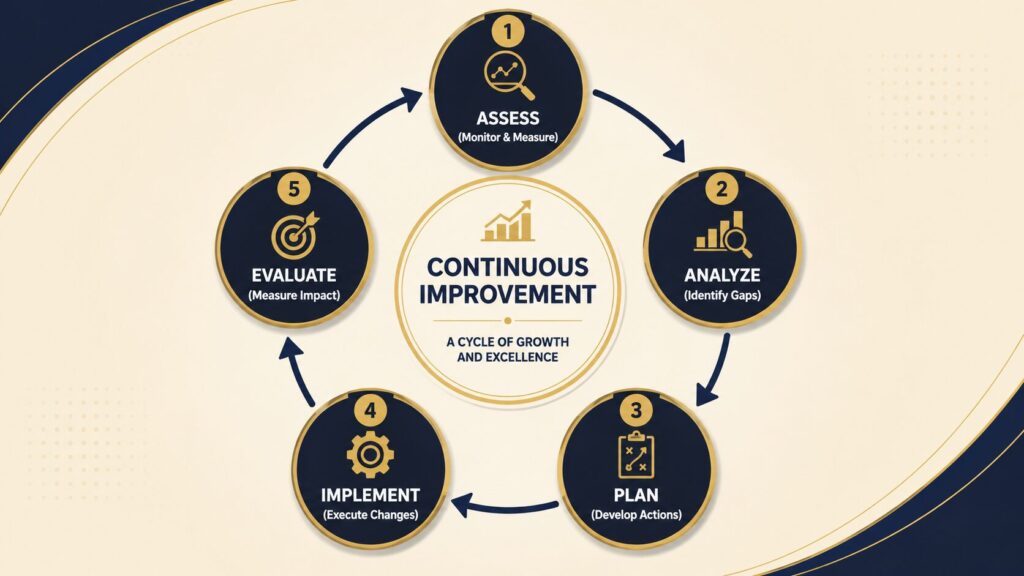
Figure 2 — RAGF Continuous Improvement Cycle
Figure Description: This figure illustrates the five-step RAGF continuous improvement cycle — Assess, Analyze, Plan, Implement, and Evaluate — showing how organizations continuously refine their AI governance practices.
This table outlines the five steps of the RAGF continuous improvement cycle — assess, analyze, plan, implement, and evaluate — with their key activities.
Table 15 — Continuous Improvement Cycle Steps
| Step | Activity | Key Questions |
|---|---|---|
| 1. Assess | Monitor and measure AI righteousness | “How are we doing? What has changed?” |
| 2. Analyze | Identify gaps and root causes | “Why are we falling short? What are the patterns?” |
| 3. Plan | Develop improvement actions | “What should we do differently?” |
| 4. Implement | Execute changes | “Are we executing effectively?” |
| 5. Evaluate | Measure impact of changes | “Did our actions produce the desired results?” |
Improvement Triggers
Table 16 — Improvement Triggers
| Trigger | Description | Response |
|---|---|---|
| RI Decline | RI scores decrease over time | Investigate root causes, implement corrective actions |
| RGS Plateau | RGS shows no improvement | Identify barriers, refresh improvement strategies |
| Incident | An AI righteousness incident occurs | Conduct root cause analysis, implement corrective actions |
| Regulatory Change | New regulations affect AI governance | Update policies and practices |
| Technology Change | New AI capabilities introduce new risks | Update risk assessments and controls |
Key Insight: Continuous improvement is not about perfection — it is about progress. Even small, incremental improvements compound over time into significant transformation (Deming, 1986).
10.6 Plan Correction: From Diagnosis to Action
The Righteousness Diagnosis (Chapter 7.8) identifies gaps between current and desired righteousness states. Plan Correction translates these diagnoses into concrete, actionable improvement plans.
The Correction Planning Process
Table 17 — Correction Planning Process
| Step | Activity | Output |
|---|---|---|
| 1 | Review Diagnosis | Review the Righteousness Diagnosis findings |
| 2 | Prioritize Gaps | Identify which gaps are most critical to address |
| 3 | Define Corrective Actions | Develop specific actions to address each gap |
| 4 | Assign Accountability | Assign owners and timelines for each action |
| 5 | Allocate Resources | Ensure adequate resources are available |
| 6 | Implement Actions | Execute the correction plan |
| 7 | Verify Effectiveness | Confirm that actions achieved desired results |
Prioritization Criteria
Table 18 — Prioritization Criteria for Corrective Actions
| Criterion | Description | Weight |
|---|---|---|
| Risk Severity | How severe is the risk posed by the gap? | High |
| Impact on Stakeholders | How many stakeholders are affected? | High |
| Regulatory Exposure | Does the gap create regulatory risk? | Medium |
| Feasibility | How feasible is the corrective action? | Medium |
| Resource Requirements | What resources are required? | Low |
Corrective Action Types
Table 19 — Corrective Action Types
| Action Type | Description | Examples |
|---|---|---|
| Policy Changes | Update or create new policies | New bias testing policy, updated data governance policy |
| Process Improvements | Improve governance processes | Streamlined incident response, enhanced review procedures |
| Technical Controls | Implement new technical safeguards | Bias detection tools, transparency mechanisms, action boundaries |
| Training | Build capability through education | AI ethics training, developer workshops |
| Structural Changes | Modify governance structures | New AI ethics committee, dedicated AI governance role |
Key Insight: A plan without action is merely a document. Plan Correction is the bridge between diagnosis and tangible improvement (Collins & Porras, 1996).
10.7 Practical Reinforcement: Education, Reflection, and Continuous Practice
Sustaining AI righteousness requires more than policies and controls — it requires building a culture of righteousness through education, reflection, and continuous practice.
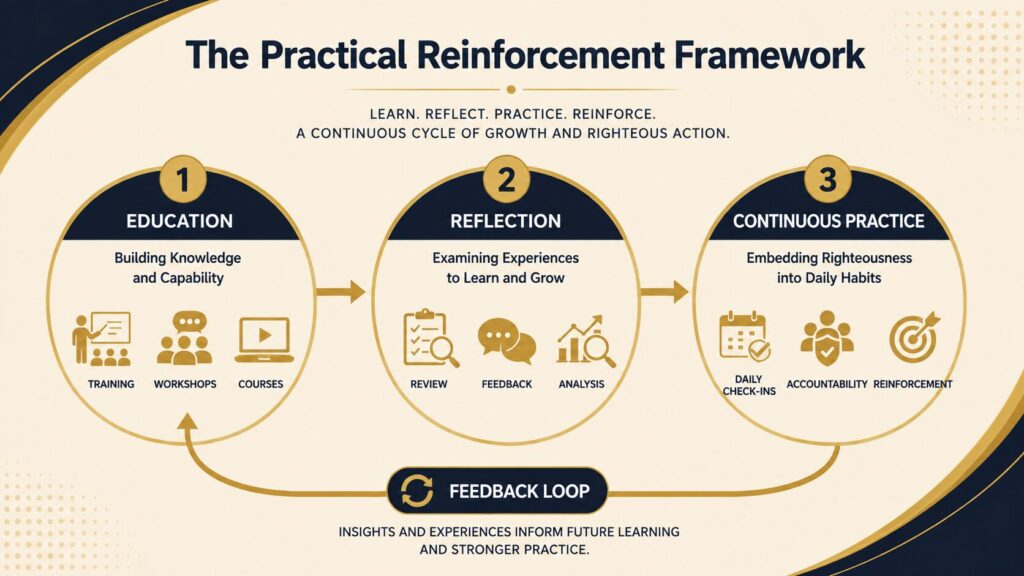
Figure 3 — Practical Reinforcement Framework
This figure illustrates the three-component practical reinforcement framework — Education (building knowledge), Reflection (examining experiences), and Continuous Practice (embedding daily habits) — showing how they work together to sustain AI righteousness.
This table outlines the three components of practical reinforcement — education, reflection, and continuous practice — with their descriptions, key activities, and expected outcomes.
Table 20 — Practical Reinforcement Framework
| Component | Description | Key Activities | Expected Outcome |
|---|---|---|---|
| Education | Building knowledge and capability | Training programs, workshops, online courses, certification | Informed, capable workforce |
| Reflection | Examining experiences to learn and grow | After-action reviews, retrospectives, ethical reflection sessions | Continuous learning, improved judgment |
| Continuous Practice | Embedding righteousness into daily habits | Regular check-ins, reinforcement activities, accountability mechanisms | Embedded culture, sustained growth |
Education
Table 21 — RAGF Education Types
| Education Type | Audience | Content |
|---|---|---|
| Foundational Training | All employees | RAGF overview, Five Pillars, importance of righteous AI |
| Role-Specific Training | Developers, data scientists | RI-D assessment, development practices, bias detection |
| Leadership Training | Executives, managers | Governance design, oversight, ethical leadership |
| Advanced Training | AI governance leads | RAGF methodology, assessment, continuous improvement |
Reflection
Table 22 — Reflection Activities
| Reflection Activity | Purpose | Frequency |
|---|---|---|
| After-Action Reviews | Learn from incidents and near-misses | After significant events |
| Ethical Reflection Sessions | Examine ethical dimensions of decisions | Quarterly |
| Governance Retrospectives | Review governance effectiveness | Semi-annually |
| Stakeholder Feedback | Gather input from affected communities | Annually |
Continuous Practice
Table 23 — Continuous Practice Activities
| Practice | Description | Frequency |
|---|---|---|
| Regular Check-ins | Review AI righteousness status | Monthly |
| Reinforcement Activities | Remind teams of righteousness principles | Weekly |
| Accountability Mechanisms | Ensure follow-through on commitments | Ongoing |
| Peer Review | Peer assessment of AI governance practices | Quarterly |
Key Insight: Righteousness is not a destination — it is a journey of continuous growth. Education builds knowledge, reflection deepens wisdom, and practice embeds righteousness into the fabric of the organization (Senge, 2006).
References
Collins, J. C., & Porras, J. I. (1996). Built to last: Successful habits of visionary companies. Harper Business.
Deming, W. E. (1986). Out of the crisis. MIT Press.
Dignum, V. (2019). Responsible artificial intelligence: How to develop and use AI in a responsible way. Springer.
European Parliament. (2024). Regulation (EU) 2024/1689 of the European Parliament and of the Council of 13 June 2024 laying down harmonised rules on artificial intelligence (Artificial Intelligence Act). Official Journal of the European Union.
Floridi, L., Cowls, J., Beltrametti, M., Chatila, R., Chazerand, P., Dignum, V., … & Vayena, E. (2018). AI4People—An ethical framework for a good AI society: Opportunities, risks, principles, and recommendations. Minds and Machines, 28(4), 689–707.
ISO/IEC. (2023). ISO/IEC 42001:2023 — Information technology — Artificial intelligence — Management system. International Organization for Standardization.
Kotter, J. P. (2012). Leading change. Harvard Business Review Press.
National Institute of Standards and Technology. (2023). Artificial Intelligence Risk Management Framework (AI RMF 1.0). U.S. Department of Commerce.
Senge, P. M. (2006). The fifth discipline: The art and practice of the learning organization (2nd ed.). Currency.
Smuha, N. A. (2021). From a ‘race to the bottom’ to a ‘race to the top’? The regulation of AI and the EU AI Act. European Journal of Legal Studies, 13(2), 45–72.