
4. Seven-Layer RAGF Governance Architecture
4.1 Overview of the Seven-Layer Architecture
4.2 Layer 1: Righteousness Foundation
4.3 Layer 2: Policy and Process
4.4 Layer 3: Map and Analyze
4.5 Layer 4: Measure and Monitor
4.6 Layer 5: Manage and Control
4.7 Layer 6: Assess Impact
4.8 Layer 7: Sustain and Improve
4.9 Applying Five Pillars Across Seven Layers
4.10 How RAGF Differs from Existing Frameworks
Part I — Foundation of RAGF
Chapter 4. Seven-Layer RAGF Governance Architecture
4.1 Overview of the Seven-Layer Architecture
The Seven-Layer Governance Architecture is the operational core of the Righteous AI Governance Framework (RAGF). While the Five Pillars define what AI righteousness means, the Seven-Layer Architecture defines how to achieve it — providing a structured, progressive methodology for translating ethical principles into governance practice.
The architecture is designed as a bottom-up progression, where each layer builds upon the foundation established by the layer below it:
Layer 7: Sustain and Improve
         ↑
Layer 6: Assess Impact
         ↑
Layer 5: Manage and Control
         ↑
Layer 4: Measure and Monitor
         ↑
Layer 3: Map and Analyze
         ↑
Layer 2: Policy and Process
         ↑
Layer 1: Righteousness Foundation
This structure reflects a core principle of the RAGF: righteousness cannot be achieved through policies alone, nor through technology alone. It requires a systematic approach that begins with foundational values and extends through continuous improvement.
This table 1 provides a high-level overview of the seven layers of the RAGF Governance Architecture, including the core question each layer addresses.
Table 1 — The Seven Layers: Overview
| Layer | Name | Core Question |
|---|---|---|
| 1 | Righteousness Foundation | “What are we committed to?” |
| 2 | Policy and Process | “How do we govern?” |
| 3 | Map and Analyze | “Where are our risks?” |
| 4 | Measure and Monitor | “How are we doing?” |
| 5 | Manage and Control | “What do we do about it?” |
| 6 | Assess Impact | “What are the results?” |
| 7 | Sustain and Improve | “How do we get better?” |
This figure 1 presents the seven layers of the RAGF Governance Architecture as a vertical progression from bottom to top. Each layer builds upon the one below it, forming a complete governance system from foundational values to continuous improvement.
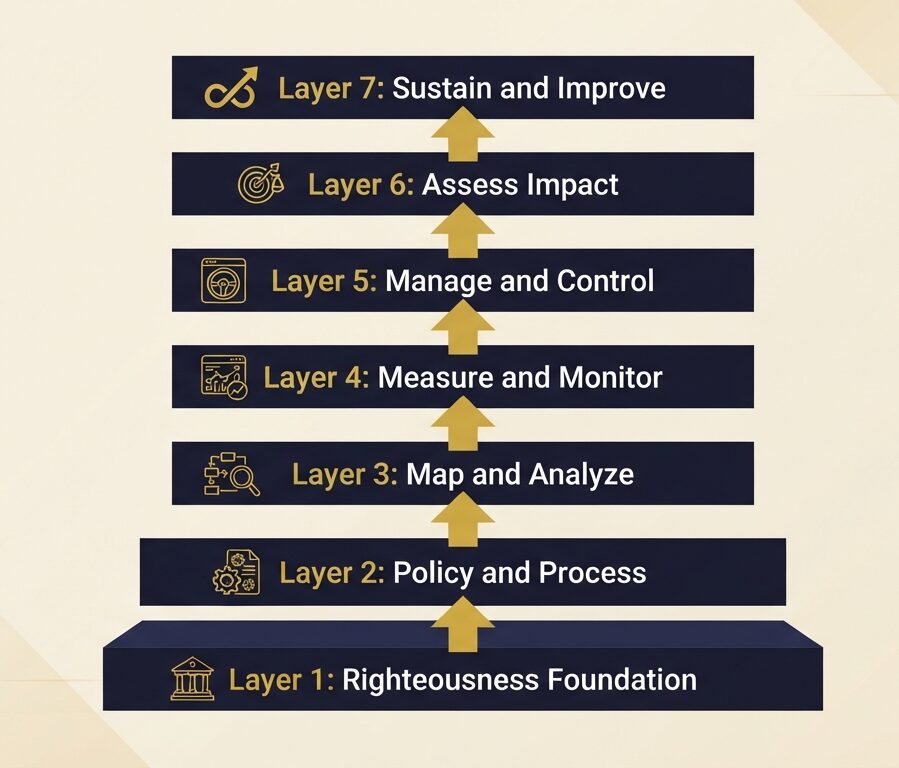
Figure 1 — The Seven-Layer RAGF Governance Architecture
4.2 Layer 1: Righteousness Foundation
Purpose: To establish the fundamental values, principles, and ethical commitments that anchor all subsequent governance activities.
The Righteousness Foundation is the bedrock of the entire RAGF architecture. Without a clear and shared understanding of what righteousness means in the context of AI, all subsequent governance activities lack direction and purpose.
This table 2 outlines the key activities for establishing the Righteousness Foundation layer.
Table 2 — Layer 1: Righteousness Foundation Activities
| Activity | Description |
|---|---|
| Define Core Values | Articulate the organization’s commitment to the Five Pillars — Integrity, Justice, Stewardship, Wisdom, and Beneficence |
| Establish Ethical Principles | Translate the Five Pillars into specific ethical principles relevant to the organization’s AI activities |
| Secure Leadership Commitment | Ensure that executive leadership visibly and actively supports the righteousness governance initiative |
| Communicate the Vision | Share the righteousness vision across the organization to build awareness and buy-in |
| Develop a Righteousness Charter | Create a formal document that codifies the organization’s commitment to righteous AI |
4.3 Layer 2: Policy and Process
Purpose: To translate foundational values into actionable policies, procedures, and governance structures.
Once the foundation is established, organizations must create the formal mechanisms through which righteousness is governed. This layer bridges the gap between commitment and action.
Policy Areas to Address:
- Data governance and privacy
- Algorithmic fairness and bias mitigation
- Transparency and explainability
- Human oversight and accountability
- Incident response and remediation
- Vendor and third-party AI governance
This table 3 outlines the key activities for establishing the Policy and Process layer.
Table 3 — Layer 2: Policy and Process Activities
| Activity | Description |
|---|---|
| Develop AI Governance Policies | Create policies that operationalize the Five Pillars in the context of AI development, deployment, and use |
| Establish Governance Structures | Define roles, responsibilities, and decision-making authorities for AI governance |
| Create Procedures and Workflows | Document the processes for implementing governance policies |
| Allocate Resources | Ensure adequate resources (budget, personnel, tools) are dedicated to AI governance |
| Define Compliance Requirements | Specify how compliance with internal policies and external regulations will be achieved |
4.4 Layer 3: Map and Analyze
Purpose: To identify, inventory, and analyze AI systems and their associated risks from a righteousness perspective.
Before organizations can measure or manage righteousness, they must understand their current state. This layer involves creating a comprehensive picture of the AI landscape within the organization.
This table 4 outlines the key activities for the Map and Analyze layer.
Table 4 — Layer 3: Map and Analyze Activities
| Activity | Description |
|---|---|
| Inventory AI Systems | Create a comprehensive inventory of all AI systems in use or development |
| Classify AI Systems | Categorize systems by risk level, function, data sensitivity, and impact |
| Map Data Flows | Understand how data moves through AI systems and where privacy or fairness risks may arise |
| Identify Stakeholders | Determine who is affected by AI systems and how |
| Conduct Risk Assessments | Evaluate risks related to the Five Pillars for each AI system |
| Document Context | Understand the operational, regulatory, and social context in which each AI system operates |
This table 5 identifies key risk questions for each of the Five Pillars during the Map and Analyze layer.
Table 5 — Risk Categories by Pillar
| Pillar | Risk Questions |
|---|---|
| Integrity | Could the AI produce deceptive or misleading outputs? |
| Justice | Could the AI discriminate against protected groups? |
| Stewardship | Are there gaps in human oversight or accountability? |
| Wisdom | Could the AI make decisions with negative long-term consequences? |
| Beneficence | Could the AI harm human well-being or the environment? |
4.5 Layer 4: Measure and Monitor
Purpose: To establish quantitative and qualitative measures of AI righteousness and to monitor performance over time.
Measurement is essential for understanding whether governance efforts are effective. This layer operationalizes the Righteousness Index (RI) and Righteousness Growth Score (RGS) as core measurement tools.
This table 6 outlines the key activities for the Measure and Monitor layer.
Table 6 — Layer 4: Measure and Monitor Activities
| Activity | Description |
|---|---|
| Define Metrics | Establish metrics for each of the Five Pillars (Integrity, Justice, Stewardship, Wisdom, Beneficence) |
| Implement RI Assessment | Conduct Righteousness Index assessments for AI systems, developers, providers, organizations, and agents |
| Establish Baselines | Determine current performance levels as a baseline for measuring improvement |
| Implement Continuous Monitoring | Deploy systems to monitor AI behavior and performance in real time |
| Collect and Analyze Data | Gather data on AI system performance, incidents, and stakeholder feedback |
| Report Findings | Communicate measurement results to relevant stakeholders |
Table 4.7: Measurement Dimensions by Pillar
This table 7 outlines the measurement dimensions for each of the Five Pillars, including example metrics.
Table 7 — Measurement Dimensions by Pillar
| Dimension | What It Measures | Example Metrics |
|---|---|---|
| Integrity | Truthfulness, transparency, absence of deception | Incidence of misleading outputs, audit pass rate |
| Justice | Fairness, non-discrimination, respect for dignity | Bias test results, equitable outcomes across groups |
| Stewardship | Oversight, accountability, risk management | Human oversight coverage, incident response time |
| Wisdom | Sound judgment, foresight, moral discernment | Decision quality assessments, long-term impact tracking |
| Beneficence | Well-being impact, sustainability | User satisfaction, environmental impact metrics |
4.6 Layer 5: Manage and Control
Purpose: To implement controls, safeguards, and interventions that ensure AI systems operate within righteous boundaries.
Measurement without action is insufficient. This layer focuses on the active management of AI systems to prevent, detect, and correct deviations from righteous behavior.
This table 8 outlines the key activities for the Manage and Control layer.
Table 8 — Layer 5: Manage and Control Activities
| Activity | Description |
|---|---|
| Implement Technical Controls | Deploy safeguards such as bias detection tools, transparency mechanisms, and action boundaries |
| Establish Human Oversight | Ensure meaningful human review for critical AI decisions |
| Create Incident Response Procedures | Develop and test procedures for responding to AI incidents |
| Enforce Policies | Ensure compliance with AI governance policies through monitoring and enforcement mechanisms |
| Manage Third-Party Risks | Oversee AI systems provided by vendors and partners |
| Conduct Audits | Perform regular internal and external audits of AI governance |
This table 9 outlines the three types of controls used in the Manage and Control layer — preventive, detective, and corrective.
Table 9 — Control Types
| Control Type | Description | Example |
|---|---|---|
| Preventive | Stop unrighteous actions before they occur | Action boundary enforcement, pre-deployment testing |
| Detective | Identify unrighteous actions after they occur | Monitoring, incident detection, audits |
| Corrective | Fix the consequences of unrighteous actions | Incident response, remediation, restoration |
4.7 Layer 6: Assess Impact
Purpose: To evaluate the broader impacts of AI systems on individuals, communities, and society, and to assess the effectiveness of governance activities.
This layer goes beyond immediate compliance and performance to consider the long-term and systemic effects of AI systems. It asks: “Are our AI systems actually contributing to human flourishing and the common good?”
This table 10 outlines the key activities for the Assess Impact layer.
Table 10 — Layer 6: Assess Impact Activities
| Activity | Description |
|---|---|
| Conduct Impact Assessments | Evaluate the social, ethical, and environmental impacts of AI systems |
| Engage Stakeholders | Seek input from affected communities and stakeholders |
| Evaluate Governance Effectiveness | Assess whether governance activities are achieving their intended outcomes |
| Identify Unintended Consequences | Detect and document unforeseen negative effects |
| Review Alignment with Values | Confirm that AI systems remain aligned with the Five Pillars |
| Document Lessons Learned | Capture insights from both successes and failures |
This table 11 outlines the key areas for impact assessment in the Assess Impact layer.
Table 11 — Impact Assessment Areas
| Area | Questions to Address |
|---|---|
| Human Well-being | Does the AI improve or diminish quality of life? |
| Social Justice | Does the AI exacerbate or reduce inequalities? |
| Environmental Sustainability | What is the AI’s environmental footprint? |
| Trust and Legitimacy | Does the AI maintain or erode public trust? |
| Long-term Consequences | What are the foreseeable long-term effects? |
4.8 Layer 7: Sustain and Improve
Purpose: To ensure that righteousness governance is not a one-time effort but a continuous, evolving practice.
The final layer closes the loop by institutionalizing continuous improvement. Righteousness is not a destination — it is an ongoing journey of growth and refinement.
This table 12 outlines the key activities for the Sustain and Improve layer.
Table 12 — Layer 7: Sustain and Improve Activities
| Activity | Description |
|---|---|
| Review and Update | Regularly review governance policies, procedures, and controls |
| Incorporate Feedback | Use feedback from measurements, assessments, and stakeholders to improve |
| Adapt to Change | Update governance practices in response to new technologies, regulations, and societal expectations |
| Share Best Practices | Disseminate lessons learned across the organization and beyond |
| Invest in Capability Development | Provide training and development to build righteousness governance capabilities |
| Track RGS | Monitor the Righteousness Growth Score to ensure continuous improvement |
4.9 Applying Five Pillars Across Seven Layers
The Five Pillars and Seven Layers are not separate components — they are integrated dimensions of a unified governance system. Each layer applies all Five Pillars in a specific governance context.
This table 13 shows how each of the Five Pillars is applied across all seven layers of the RAGF Governance Architecture.
Table 13 — Pillar-Layer Integration Matrix
| Pillar | Layer 1 | Layer 2 | Layer 3 | Layer 4 | Layer 5 | Layer 6 | Layer 7 |
|---|---|---|---|---|---|---|---|
| Integrity | Define truthfulness as core value | Create truthfulness policies | Identify deception risks | Measure truthfulness | Implement truthfulness controls | Assess truthfulness impact | Improve truthfulness |
| Justice | Define fairness as core value | Create anti-discrimination policies | Identify bias risks | Measure fairness | Implement bias controls | Assess fairness impact | Improve fairness |
| Stewardship | Define responsibility as core value | Create accountability policies | Identify oversight gaps | Measure governance | Implement oversight controls | Assess governance impact | Improve governance |
| Wisdom | Define prudence as core value | Create decision quality policies | Identify poor decision risks | Measure decision quality | Implement decision controls | Assess decision impact | Improve decision quality |
| Beneficence | Define human flourishing as goal | Create impact policies | Identify negative impact risks | Measure positive impact | Implement impact controls | Assess well-being impact | Improve positive impact |
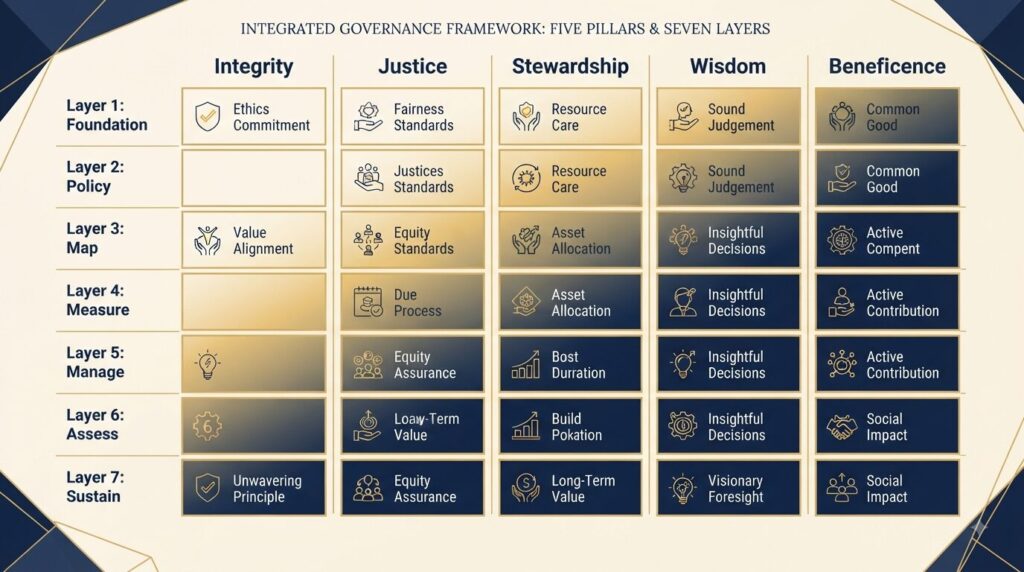
Figure 2 — Pillar-Layer Integration
This figure 2 illustrates how the Five Pillars of AI Righteousness are integrated across the Seven-Layer Governance Architecture, showing the relationship between pillars (horizontal) and layers (vertical).
4.10 How RAGF Differs from Existing Frameworks
The RAGF Seven-Layer Architecture differs fundamentally from existing AI governance frameworks in several important ways.
This table 14 compares RAGF with three major existing AI governance frameworks — NIST AI RMF, EU AI Act, and ISO/IEC 42001 — across seven key dimensions.
Table 14 — RAGF vs. Existing Frameworks
| Dimension | NIST AI RMF | EU AI Act | ISO/IEC 42001 | RAGF |
|---|---|---|---|---|
| Core Focus | Risk Management | Legal Compliance | Management System | Moral Governance |
| Structure | Four Functions (Govern, Map, Measure, Manage) | Risk Tiers + Requirements | Clauses + Annex Controls | Seven Interdependent Layers |
| Underlying Philosophy | “Manage AI Risks” | “Ensure AI Safety” | “Establish AI Management” | “Pursue AI Righteousness” |
| Measurement | Qualitative | Compliance/Non-Compliance | Process Compliance | Continuous RI + RGS |
| Scope | AI Systems | AI Products | AI Management | Full AI Lifecycle + Culture |
| Value Orientation | Trustworthy AI | Safe AI | Managed AI | Righteous AI |
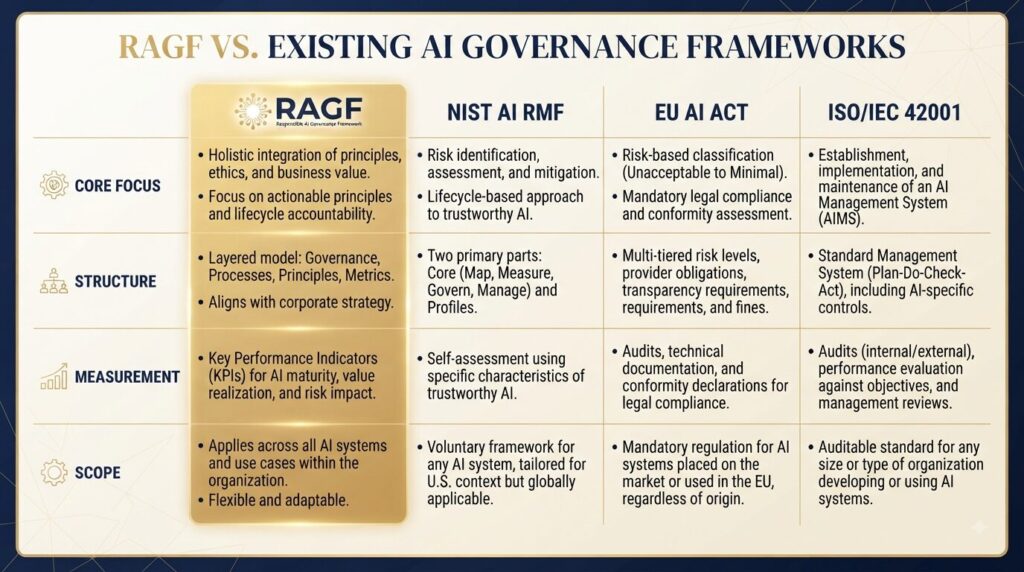
Figure 3 — RAGF vs. Existing Frameworks: Visual Comparison
This figure 3 provides a visual comparison of RAGF with NIST AI RMF, EU AI Act, and ISO/IEC 42001 across four dimensions: Core Focus, Structure, Measurement, and Scope.
Key Differentiators
- Moral Foundation: Unlike NIST AI RMF’s focus on risk management or the EU AI Act’s focus on legal compliance, RAGF is grounded in moral values — Integrity, Justice, Stewardship, Wisdom, and Beneficence.
- Continuous Measurement: While other frameworks offer one-time assessments or periodic audits, RAGF provides continuous measurement through the Righteousness Index (RI) and Righteousness Growth Score (RGS), enabling organizations to track improvement over time.
- Full Lifecycle Coverage: RAGF covers the entire AI ecosystem — from developers and providers to deploying organizations, AI agents, and robots.
- Progressive Architecture: The seven-layer structure provides a clear maturation path from foundational values to continuous improvement, unlike the more static structures of other frameworks.
- Value-Driven, Not Just Risk-Driven: RAGF asks not only “What could go wrong?” but also “What could we become?” — making righteousness an aspirational goal rather than merely a risk to be managed.
This table 15 provides guidance on which framework to use for different AI governance needs.
Table 15 — When to Use Each Framework
| Use Case | Recommended Framework |
|---|---|
| Managing AI risks in a general context | NIST AI RMF |
| Ensuring legal compliance with EU regulations | EU AI Act |
| Establishing a certifiable AI management system | ISO/IEC 42001 |
| Building a culture of righteousness and moral excellence in AI | RAGF |
References
Dignum, V. (2019). Responsible artificial intelligence: How to develop and use AI in a responsible way. Springer.
European Parliament. (2024). Regulation (EU) 2024/1689 of the European Parliament and of the Council of 13 June 2024 laying down harmonised rules on artificial intelligence (Artificial Intelligence Act). Official Journal of the European Union.
Floridi, L., & Cowls, J. (2019). A unified framework of five principles for AI in society. Harvard Data Science Review, 1(1).
Floridi, L., Cowls, J., Beltrametti, M., Chatila, R., Chazerand, P., Dignum, V., … & Vayena, E. (2018). AI4People—An ethical framework for a good AI society: Opportunities, risks, principles, and recommendations. Minds and Machines, 28(4), 689–707.
ISO/IEC. (2023). ISO/IEC 42001:2023 — Information technology — Artificial intelligence — Management system. International Organization for Standardization.
Jobin, A., Ienca, M., & Vayena, E. (2019). The global landscape of AI ethics guidelines. Nature Machine Intelligence, 1(9), 389–399.
National Institute of Standards and Technology. (2023). Artificial Intelligence Risk Management Framework (AI RMF 1.0). U.S. Department of Commerce.
OECD. (2019). OECD Principles on Artificial Intelligence. OECD Publishing.
Russell, S. (2019). Human compatible: Artificial intelligence and the problem of control. Viking.
Smuha, N. A. (2021). From a ‘race to the bottom’ to a ‘race to the top’? The regulation of AI and the EU AI Act. European Journal of Legal Studies, 13(2), 45–72.