
5.1 From Ethical Principles to Quantitative Measurement
5.2 Righteousness Index Overview
5.3 RI‑D: Developer Righteousness Index
5.4 RI‑P: AI Provider Righteousness Index
5.5 RI‑O: Organization Righteousness Index
5.6 RI‑A: AI Agent Righteousness Index
5.7 RI‑R: Robot Righteousness Index
5.8 RI‑U: User Righteousness Index
5.9 RI Calculation Methodology
Part II — RAGF Measurement and Assessment System
5.1 From Ethical Principles to Quantitative Measurement
The Five Pillars of AI Righteousness—Integrity, Justice, Stewardship, Wisdom, and Beneficence—provide a moral foundation for AI governance. However, principles alone are insufficient for effective governance. Organizations need measurable, auditable, and trackable indicators to assess whether their AI systems are actually operating righteously.
This is the purpose of the Righteousness Index (RI): to translate ethical principles into quantitative metrics that can be:
- Measured — Assessed through standardized evaluations
- Monitored — Tracked over time to detect changes
- Compared — Benchmarked across systems, teams, and organizations
- Improved — Used to drive continuous growth in righteousness
The Measurement Challenge
Measuring righteousness presents unique challenges:
The table 1 identifies the four key challenges in measuring AI righteousness — subjectivity, complexity, context-dependence, and quantifiability — and explains how the RI approach addresses each.
Table 1 — The Measurement Challenge
| Challenge | Description | RI Approach |
|---|---|---|
| Subjectivity | Righteousness involves moral judgment, which can vary across individuals and cultures | RI uses standardized criteria grounded in the Five Pillars and operationalized through concrete, observable indicators |
| Complexity | Righteousness is multi-dimensional, involving values, behaviors, and outcomes | RI employs a multi-dimensional framework that separately assesses each pillar |
| Context-Dependence | What constitutes righteous behavior may depend on the specific context | RI provides role-specific indices that account for different stakeholder responsibilities |
| Quantifiability | Moral qualities are not naturally numerical | RI uses observable indicators and behavioral evidence that can be systematically evaluated |
From Principles to Metrics — The RI Framework
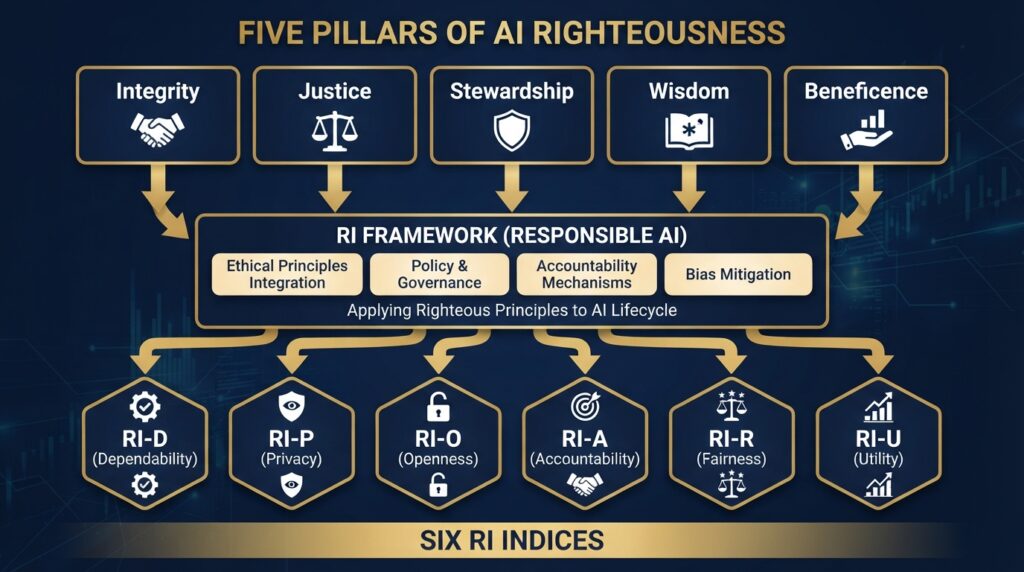
Figure 1 — From Principles to Metrics: The RI Framework
This figure illustrates the progression from the Five Pillars of AI Righteousness to the Righteousness Index (RI) measurement system, showing how abstract principles are operationalized into concrete metrics.
5.2 Righteousness Index Overview
The Righteousness Index (RI) is a multi-dimensional measurement system that evaluates AI righteousness across the full AI lifecycle. It consists of six distinct indices, each tailored to a specific stakeholder group:
This table 2 provides an overview of the five Righteousness Index variants, including their focus, purpose, and primary assessment method.
Table 2 — The Righteousness Index (RI) Family
| Index | Focus | Purpose | Primary Assessment Method |
|---|---|---|---|
| RI‑D | AI Developers | Assess righteousness in AI development practices | Development process review, code audits, design documentation |
| RI‑P | AI Providers | Assess righteousness in AI platform and service delivery | Platform governance review, service monitoring, user feedback |
| RI‑O | AI-Deploying Organizations | Assess righteousness in organizational AI governance | Organizational policy review, governance structure assessment |
| RI‑A | AI Agents | Assess righteousness in autonomous AI agent behavior | Behavioral monitoring, decision analysis, value alignment testing |
| RI‑R | AI Robots | Assess righteousness in embodied AI systems | Physical behavior monitoring, safety audits, human interaction analysis |
| RI‑U | AI Users (Human) | Assess righteousness of human users in their AI usage practices | User behavior review, AI usage disclosure, decision verification |
Core Principle
All RI variants share a common foundation: they evaluate performance against the Five Pillars of AI Righteousness (Integrity, Justice, Stewardship, Wisdom, and Beneficence). Each variant operationalizes these pillars in a way that is appropriate to the specific stakeholder context.
This table 3 shows how each of the six RI variants applies the Five Pillars of AI Righteousness in their specific context.
Table 3 — RI Variants and the Five Pillars
| Pillar | RI‑D (Developer) | RI‑P (Provider) | RI‑O (Organization) | RI‑A (Agent) | RI‑R (Robot) | RI‑U (User) |
|---|---|---|---|---|---|---|
| Integrity | Code honesty, no hidden functionality | Service truthfulness, accurate capability claims | Policy transparency, no misleading statements | Truthful outputs, no deception | Honest reporting, no hidden behaviors | Honest AI use disclosure, no deception via AI |
| Justice | Fair data practices, bias mitigation | Equitable service access, non-discrimination | Fair AI deployment, equitable outcomes | Fair decisions, no discrimination | Fair treatment, equitable physical interaction | Fair use of AI, no discrimination via AI |
| Stewardship | Responsible development, ethical design | Platform governance, user protection | Organizational oversight, accountability | Responsible action, authorized behavior | Safe operation, human oversight | Responsible AI use, verification of outputs |
| Wisdom | Prudent design choices, risk awareness | Service robustness, contingency planning | Strategic AI governance, long-term thinking | Sound judgment, consequence awareness | Safe physical judgment, risk assessment | Prudent AI use, knowing when not to use AI |
| Beneficence | Positive social impact consideration | Service contributes to well-being | AI serves organizational mission and public good | Actions promote human flourishing | Physical actions promote safety and well-being | Using AI to promote human flourishing, avoiding harm |
5.3 RI-D: Developer Righteousness Index
Purpose: To assess the righteousness of AI development practices.
Who It Applies To: AI developers, data scientists, machine learning engineers, and development teams involved in creating AI systems.
Why It Matters: The righteousness of AI systems is largely determined during development. If developers embed righteous principles into the design, data selection, and training processes, the resulting AI is more likely to behave righteously.
Assessment Dimensions
This table 4 outlines the key assessment dimensions for the Developer Righteousness Index (RI-D), organized by the Five Pillars.
Table 4 — RI-D Assessment Dimensions
| Pillar | Assessment Dimension | Key Questions |
|---|---|---|
| Integrity | Code Transparency | Is the code open to review? Are hidden functionalities disclosed? |
| Integrity | Truthful Documentation | Do documentation and specifications accurately describe system capabilities and limitations? |
| Justice | Bias Detection & Mitigation | Are bias tests conducted? Is bias actively mitigated? |
| Justice | Fair Data Practices | Is training data representative? Are protected groups considered? |
| Stewardship | Ethical Design Process | Is ethics considered throughout the development lifecycle? |
| Stewardship | Governance Compliance | Do development practices comply with relevant policies and standards? |
| Wisdom | Risk Assessment | Are potential risks identified and assessed before deployment? |
| Wisdom | Prudent Design | Are design choices made with foresight and caution? |
| Beneficence | Social Impact Consideration | Is positive societal impact considered in design decisions? |
| Beneficence | Environmental Impact | Is the environmental footprint of development considered? |
RI-D Score Interpretation
This table 5 provides score interpretation guidelines for the Developer Righteousness Index (RI-D), including ratings and descriptions.
Table 5 — RI-D Score Interpretation
| Score Range | Rating | Description |
|---|---|---|
| 80–100 | Righteous | Exemplary development practices; righteousness is embedded in the development culture |
| 60–79 | Proficient | Solid development practices; righteousness is considered but could be strengthened |
| 40–59 | Developing | Foundational practices in place; significant improvement opportunities exist |
| 20–39 | Emerging | Basic awareness exists; development practices need substantial improvement |
| 0–19 | Unassessed | No systematic righteousness assessment has been conducted |
5.4 RI-P: AI Provider Righteousness Index
Purpose: To assess the righteousness of AI platform and service delivery.
Who It Applies To: AI platform providers, cloud service providers, AI-as-a-service companies, and organizations that host and deliver AI capabilities to others.
Why It Matters: Providers are responsible for ensuring that the AI services they deliver are righteous. This includes platform governance, user protection, and transparent service delivery.
Assessment Dimensions
This table o 6 utlines the key assessment dimensions for the AI Provider Righteousness Index (RI-P), organized by the Five Pillars.
Table 6 — RI-P Assessment Dimensions
| Pillar | Assessment Dimension | Key Questions |
|---|---|---|
| Integrity | Service Transparency | Are service capabilities and limitations clearly communicated to users? |
| Integrity | Truthful Marketing | Do marketing claims accurately reflect actual capabilities? |
| Justice | Equitable Access | Is service access equitable across different user groups? |
| Justice | Non-Discrimination | Does the service discriminate against protected groups? |
| Stewardship | Platform Governance | Are there clear governance structures for platform operation? |
| Stewardship | User Protection | Are users protected from harm through the service? |
| Wisdom | Service Robustness | Is the service designed with appropriate safeguards and contingency plans? |
| Wisdom | Continuous Improvement | Is the service regularly reviewed and improved? |
| Beneficence | Well-Being Contribution | Does the service contribute to user and societal well-being? |
| Beneficence | Environmental Stewardship | Is the environmental impact of the service managed? |
RI-P Score Interpretation
This table 7 provides score interpretation guidelines for the AI Provider Righteousness Index (RI-P), including ratings and descriptions.
Table 7 — RI-P Score Interpretation
| 80–100 | Righteous | Exemplary provider practices; righteousness is embedded in service delivery |
| 60–79 | Proficient | Solid provider practices; righteousness is considered but could be strengthened |
| 40–59 | Developing | Foundational practices in place; significant improvement opportunities exist |
| 20–39 | Emerging | Basic awareness exists; provider practices need substantial improvement |
| 0–19 | Unassessed | No systematic righteousness assessment has been conducted |
5.5 RI-O: Organization Righteousness Index
Purpose: To assess the righteousness of organizational AI governance.
Who It Applies To: Organizations that deploy, use, or govern AI systems — including enterprises, government agencies, non-profits, and any institution that uses AI in its operations.
Why It Matters: Organizations are ultimately accountable for the AI systems they deploy. Organizational governance structures, policies, and culture determine whether AI is used righteously.
Assessment Dimensions
The table 8 outlines the key assessment dimensions for the Organization Righteousness Index (RI-O), organized by the Five Pillars.
Table 8 — RI-O Assessment Dimensions
| Pillar | Assessment Dimension | Key Questions |
|---|---|---|
| Integrity | Policy Transparency | Are AI governance policies transparent and accessible? |
| Integrity | Honest Communication | Does the organization honestly communicate about its AI systems? |
| Justice | Fair Deployment | Are AI systems deployed fairly across the organization and to stakeholders? |
| Justice | Equitable Outcomes | Do AI systems produce equitable outcomes? |
| Stewardship | Governance Structure | Is there a clear governance structure for AI oversight? |
| Stewardship | Accountability | Are roles and responsibilities for AI governance clearly defined? |
| Wisdom | Strategic Governance | Is AI governance aligned with long-term organizational strategy? |
| Wisdom | Risk Management | Are AI risks identified, assessed, and managed? |
| Beneficence | Mission Alignment | Does AI serve the organization’s mission and public good? |
| Beneficence | Stakeholder Well-Being | Does AI deployment consider stakeholder well-being? |
RI-O Score Interpretation
This table 9 provides score interpretation guidelines for the Organization Righteousness Index (RI-O), including ratings and descriptions.
Table 9 — RI-O Score Interpretation
| Score Range | Rating | Description |
|---|---|---|
| 80–100 | Righteous | Exemplary organizational governance; righteousness is embedded in organizational culture |
| 60–79 | Proficient | Solid governance practices; righteousness is considered but could be strengthened |
| 40–59 | Developing | Foundational practices in place; significant improvement opportunities exist |
| 20–39 | Emerging | Basic awareness exists; organizational governance needs substantial improvement |
| 0–19 | Unassessed | No systematic righteousness assessment has been conducted |
5.6 RI-A: AI Agent Righteousness Index
Purpose: To assess the righteousness of autonomous AI agent behavior.
Who It Applies To: Autonomous AI agents — systems that make decisions and take actions with limited or no human supervision.
Why It Matters: Autonomous AI agents pose unique risks because they operate without continuous human oversight. Their decisions and actions must be monitored for righteousness, and they must be held accountable for unrighteous behavior.
Assessment Dimensions
This table 10 outlines the key assessment dimensions for the AI Agent Righteousness Index (RI-A), organized by the Five Pillars.
Table 10 — RI-A Assessment Dimensions
| Pillar | Assessment Dimension | Key Questions |
|---|---|---|
| Integrity | Truthfulness | Does the agent tell the truth? Does it fabricate information? |
| Integrity | Transparency | Does the agent disclose its limitations and uncertainties? |
| Integrity | No Deception | Does the agent engage in deceptive behavior (identity fabrication, hiding mistakes)? |
| Justice | Non-Discrimination | Does the agent discriminate against protected groups? |
| Justice | Fair Treatment | Does the agent treat all individuals and groups equitably? |
| Stewardship | Authorized Action | Does the agent act within authorized boundaries? |
| Stewardship | Human Oversight | Is there meaningful human oversight of the agent’s actions? |
| Wisdom | Sound Judgment | Does the agent make prudent decisions? |
| Wisdom | Consequence Awareness | Does the agent anticipate and consider consequences? |
| Beneficence | Positive Impact | Does the agent’s behavior promote human well-being? |
| Beneficence | Avoid Harm | Does the agent avoid causing harm? |
RI-A Score Interpretation
This table11 provides score interpretation guidelines for the AI Agent Righteousness Index (RI-A), including ratings and descriptions.
Table 11 — RI-A Score Interpretation
| Score Range | Rating | Description |
|---|---|---|
| 80–100 | Righteous | Exemplary agent behavior; the agent consistently acts righteously |
| 60–79 | Proficient | Solid agent behavior; righteousness is generally demonstrated |
| 40–59 | Developing | Foundational behavior in place; significant improvement needed |
| 20–39 | Emerging | Basic behavior patterns exist; agent behavior needs substantial improvement |
| 0–19 | Unassessed | No systematic righteousness assessment has been conducted |
5.7 RI-R: Robot Righteousness Index
Purpose: To assess the righteousness of embodied AI systems (robots) in physical environments.
Who It Applies To: Physical AI systems — robots, autonomous vehicles, drones, and other embodied AI that interact with the physical world.
Why It Matters: Embodied AI systems operate in the physical world, where their actions can have direct physical consequences for humans, animals, and the environment. Their behavior must be monitored for safety, respect for human dignity, and environmental responsibility.
Assessment Dimensions
This table 12 outlines the key assessment dimensions for the Robot Righteousness Index (RI-R), organized by the Five Pillars.
Table 12 — RI-R Assessment Dimensions
| Pillar | Assessment Dimension | Key Questions |
|---|---|---|
| Integrity | Honest Reporting | Does the robot accurately report its status and actions? |
| Integrity | Transparency | Are the robot’s capabilities and limitations clearly communicated? |
| Justice | Equitable Treatment | Does the robot treat all humans equitably? |
| Justice | Respect for Dignity | Does the robot respect human dignity in its interactions? |
| Stewardship | Safety | Is the robot operated safely? |
| Stewardship | Human Oversight | Is there meaningful human oversight of the robot’s actions? |
| Wisdom | Physical Judgment | Does the robot make safe and prudent physical judgments? |
| Wisdom | Risk Assessment | Does the robot assess and avoid physical risks? |
| Beneficence | Human Well-Being | Does the robot’s physical actions promote human well-being? |
| Beneficence | Environmental Responsibility | Does the robot consider its environmental impact? |
RI-R Score Interpretation
This table 13 provides score interpretation guidelines for the Robot Righteousness Index (RI-R), including ratings and descriptions.Table 13 — RI-R Score Interpretation
Table 13 RI-R Score Interpretation
| Score Range | Rating | Description |
|---|---|---|
| 80–100 | Righteous | Exemplary robot behavior; the robot consistently acts righteously in physical environments |
| 60–79 | Proficient | Solid robot behavior; righteousness is generally demonstrated |
| 40–59 | Developing | Foundational behavior in place; significant improvement needed |
| 20–39 | Emerging | Basic behavior patterns exist; robot behavior needs substantial improvement |
| 0–19 | Unassessed | No systematic righteousness assessment has been conducted |
5.8 RI‑U: User Righteousness Index
Purpose: To assess the righteousness of human users in their AI usage practices.
Who It Applies To: End users of AI systems across all domains — teachers, doctors, lawyers, financial analysts, government officials, journalists, students, employees, and citizens.
Why It Matters: The righteousness of AI systems depends not only on how they are developed and governed, but also on how they are used. Even the most righteous AI can be used for unrighteous purposes if users lack integrity, wisdom, or accountability.
This table outlines the key assessment dimensions for the User Righteousness Index (RI‑U), organized by several Pillars.
Table 14 — RI‑U Assessment Dimensions
| Pillar | Assessment Dimension | Key Questions |
|---|---|---|
| Integrity | Honest Use | Does the user honestly disclose AI usage? Does the user avoid using AI to deceive others? |
| Integrity | Transparency | Does the user clearly communicate when and how AI was used? |
| Justice | Fair Use | Does the user use AI fairly toward all individuals and groups? |
| Justice | Non-Discrimination | Does the user avoid using AI to discriminate against protected groups? |
| Stewardship | Responsible Use | Does the user take responsibility for AI-assisted decisions? |
| Stewardship | Verification | Does the user verify AI outputs before relying on them? |
| Wisdom | Prudent Use | Does the user know when to use AI and when not to? |
| Wisdom | Critical Evaluation | Does the user critically evaluate AI outputs rather than blindly accepting them? |
| Beneficence | Beneficial Use | Does the user use AI to promote human flourishing? |
| Beneficence | Harm Avoidance | Does the user avoid using AI to cause harm? |
This table shows how RI‑U applies across different domains and user roles.
Table 15 — RI‑U Domain Adaptations
| Domain | User Role | Key RI‑U Focus Areas |
|---|---|---|
| Education | Student, Teacher | Academic integrity, AI disclosure, learning vs. outsourcing |
| Healthcare | Doctor, Nurse | Diagnostic verification, patient safety, clinical judgment |
| Finance | Analyst, Trader | Transaction integrity, market fairness, risk verification |
| Law | Lawyer, Judge | Evidence verification, legal ethics, fair representation |
| Government | Official, Policymaker | Policy transparency, citizen rights, public trust |
| Media | Journalist, Editor | Content authenticity, source verification, public truth |
RI‑U Score Interpretation
Table 16 – RI-U Score Interpretation
| Score Range | Rating | Description |
|---|---|---|
| 80–100 | Righteous | Exemplary user behavior; AI is used with integrity and wisdom |
| 60–79 | Proficient | Solid user behavior; generally righteous with room for improvement |
| 40–59 | Developing | Some righteous practices in place; significant gaps exist |
| 20–39 | Emerging | Basic awareness exists; user behavior needs substantial improvement |
| 0–19 | Unassessed | No systematic assessment of user righteousness has been conducted |
5.9 RI Calculation Methodology
The Righteousness Index (RI) is calculated through a structured, multi-step methodology that ensures consistency, transparency, and comparability across assessments.
Core Calculation Steps
This table outlines the seven-step process for calculating the Righteousness Index (RI), including the activities and outputs for each step.
Table 17 — RI Calculation Steps
| Step | Activity | Output |
|---|---|---|
| 1 | Determine the Assessment Context | Identify the RI variant (RI-D, RI-P, RI-O, RI-A, RI-R, RI-U) and the specific system, team, or organization being assessed |
| 2 | Collect Evidence | Evidence across all Pillars: documentation, technical analysis, behavioral monitoring, stakeholder feedback, performance data |
| 3 | Score Each Dimension | Scores (0–100) for each assessment dimension based on evidence |
| 4 | Calculate Pillar Scores | Average of all dimension scores within each pillar |
| 5 | Calculate Overall RI Score | Weighted average of all Pillar Scores |
| 6 | Assign Rating | Rating based on RI Score (Righteous, Proficient, Developing, Emerging, Unassessed) |
| 7 | Document and Report | Assessment report with RI Score, Pillar Scores, key findings, and recommendations |
RI Weighting by Variant
This table shows the recommended weightings for each of the Five Pillars across the five RI variants, reflecting their relative importance in each context.
Table 18 — RI Weighting by Variant
| Pillar | RI-D | RI-P | RI-O | RI-A | RI-R | RI-U |
|---|---|---|---|---|---|---|
| Integrity | 25% | 25% | 20% | 25% | 20% | 25% |
| Justice | 20% | 20% | 20% | 20% | 25% | 20% |
| Stewardship | 20% | 25% | 25% | 20% | 25% | 20% |
| Wisdom | 20% | 15% | 20% | 20% | 15% | 20% |
| Beneficence | 15% | 15% | 15% | 15% | 15% | 15% |
| Total | 100% | 100% | 100% | 100% | 100% | 100% |
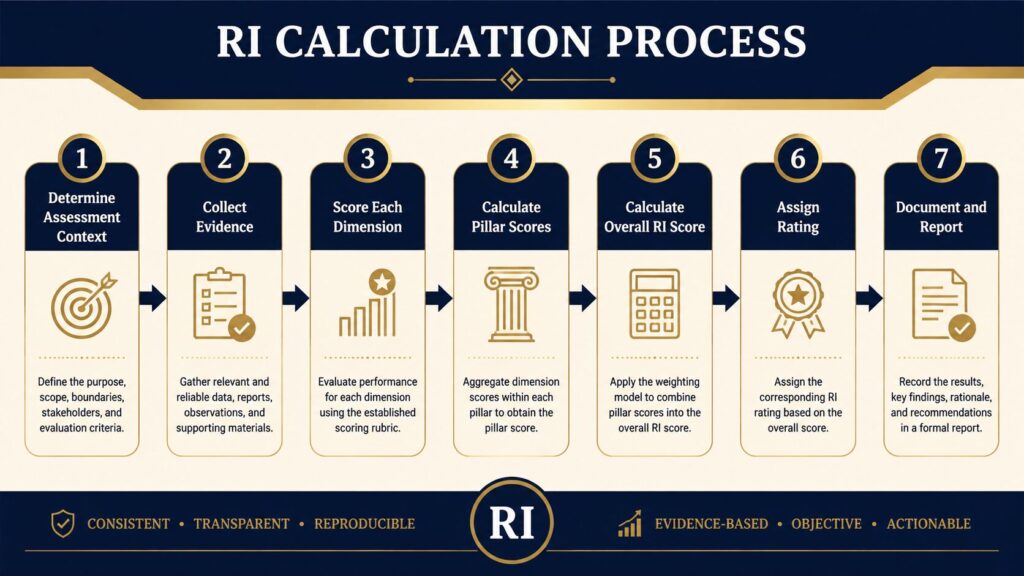
Figure 2 — RI Calculation Process
This figure 2 illustrates the seven-step process for calculating the Righteousness Index (RI), from determining the assessment context to documenting and reporting the results.
This table provides a general interpretation of RI scores across all RI variants.
Table 19 — RI Score Interpretation
| Score Range | Rating | Description |
|---|---|---|
| 80–100 | Righteous | Exemplary righteousness; practices are comprehensive and fully embedded |
| 60–79 | Proficient | Solid righteousness; practices are generally effective but could be improved |
| 40–59 | Developing | Foundational practices in place; significant improvement opportunities exist |
| 20–39 | Emerging | Basic awareness exists; practices need substantial improvement |
| 0–19 | Unassessed | No systematic assessment has been conducted |
References
Deci, E. L., & Ryan, R. M. (1985). Intrinsic motivation and self-determination in human behavior. Plenum Press.
Dignum, V. (2019). Responsible artificial intelligence: How to develop and use AI in a responsible way. Springer.
European Parliament. (2024). Regulation (EU) 2024/1689 of the European Parliament and of the Council of 13 June 2024 laying down harmonised rules on artificial intelligence (Artificial Intelligence Act). Official Journal of the European Union.
Floridi, L., & Cowls, J. (2019). A unified framework of five principles for AI in society. Harvard Data Science Review, 1(1).
Floridi, L., Cowls, J., Beltrametti, M., Chatila, R., Chazerand, P., Dignum, V., … & Vayena, E. (2018). AI4People—An ethical framework for a good AI society: Opportunities, risks, principles, and recommendations. Minds and Machines, 28(4), 689–707.
ISO/IEC. (2023). ISO/IEC 42001:2023 — Information technology — Artificial intelligence — Management system. International Organization for Standardization.
Jobin, A., Ienca, M., & Vayena, E. (2019). The global landscape of AI ethics guidelines. Nature Machine Intelligence, 1(9), 389–399.
National Institute of Standards and Technology. (2023). Artificial Intelligence Risk Management Framework (AI RMF 1.0). U.S. Department of Commerce.
OECD. (2019). OECD Principles on Artificial Intelligence. OECD Publishing.
Ryan, R. M., & Deci, E. L. (2017). Self-determination theory: Basic psychological needs in motivation, development, and wellness. Guilford Press.
Smuha, N. A. (2021). From a race to the bottom to a race to the top? The regulation of AI and the EU AI Act. European Journal of Legal Studies, 13(2), 45–72.