
Joint Nearby School Traffic Method (JNSTM): A New Method for Adjacent School Traffic Management
WiseInnovationMethods · Method Analysis
WiseRighteous Network
Abstract
The Joint Nearby School Traffic Method (JNSTM) is a effective, replicable method for reducing both drop-off and pick-up congestion at two nearby schools that do not share a campus or driveway, but are close enough that students can walk between them in a few minutes. Each school retains its own driveway, its own schedule, and its own traffic plan. The method is built on a cross-campus drop-off and pick-up model: during School A’s drop-off or pick-up window, parents may use School B’s empty driveway — because School B is not in session at that time — and the student walks a short distance (typically three minutes) to or from School A. The process reverses during School B’s drop-off and pick-up window. JNSTM combines four components: confirmed staggered bell times, a formal coordination agreement, clearly designated drop-off, pick-up, and walking zones, and professionally managed public-road traffic control. This analysis examines the legal, operational, planning, and financial dimensions of JNSTM, including memorandum of understanding (MOU) frameworks, insurance and liability requirements, police and crossing-guard authority, cost-benefit analysis, regulatory alignment, stakeholder roles, measurable outcomes, and new-school design integration. A case example from Jordan High School and Adam Junior High School illustrates the method in practice. The analysis concludes with adoption pathways, funding options, and recommendations for government agencies, school districts, builders, and police departments.
1. Introduction
When two schools are located near each other — most commonly a high school and a junior high school — their drop-off and pick-up traffic interacts even though the schools are separate institutions with their own campuses, driveways, and schedules.
In the United States, this configuration is common. A high school and a junior high school may sit across the street from each other, share a property line, or be separated by only a short walk. In most districts, these schools already operate on different bell schedules. Their arrival and dismissal windows do not fully overlap.
This creates a structural inefficiency that affects both morning drop-off and afternoon pick-up. At any given time, one school is in session and its driveway is congested, while the nearby school is not in session and its driveway sits empty. Yet because the two schools do not coordinate, that empty driveway is not available to relieve the congested one.
The Joint Nearby School Traffic Method (JNSTM) solves this by allowing parents from the active school to use the empty driveway of the inactive school during both drop-off and pick-up, with students walking the short distance between campuses.
JNSTM is not a one-time fix. It is an ongoing coordination process supported by a written agreement, clear physical design, and professional traffic control. It can be implemented at existing schools through retrofit and at new schools through design integration.
2. The Problem
The core problem is isolated traffic management between nearby schools with mismatched bell schedules.
In most U.S. districts, nearby schools operate on different bell schedules. Their arrival and dismissal windows do not fully overlap. Each school has its own driveway and its own congestion during its own peak — both in the morning and in the afternoon. Each school’s driveway sits partially idle when that school is not in session — while the nearby school is at peak.
The real problem is not shared infrastructure and not overlapping peaks. The real problem is that two nearby schools are not coordinating, even though coordination would allow:
- Parents from the active school to use the empty driveway of the inactive school, both in the morning and in the afternoon
- Students to walk a short distance (typically three minutes) between campuses
- Each school to reduce congestion during its own peak without new construction
- Both schools to share traffic control resources and parent communication
- Public-street congestion near both schools to be reduced
JNSTM solves this by establishing a formal coordination framework between the two schools.
2.1 Secondary Problems
- Safety risk for students. Mixed traffic modes — buses, cars, walkers, and bicyclists — increase the chance of conflicts and accidents at each school, during both drop-off and pick-up.
- Liability exposure for districts. Staff directing traffic on public roads without legal authority creates negligence risk.
- Operational inefficiency. Duplicated traffic control efforts cost more than coordinated ones.
- Parent frustration. Longer wait times and confusing routes reduce satisfaction at both schools, morning and afternoon.
- Community impact. Backups on public streets affect neighbors and local businesses near both schools.
- Unused capacity. Each school’s driveway sits idle when that school is not in session, while the nearby school is at peak — both in the morning and in the afternoon.
3. The Method: Four Components
JNSTM has four interlocking components. Each can be implemented independently, but the method works best when all four are combined.
3.1 Confirmed Staggered Bell Times
In most U.S. districts with a high school and a junior high school nearby, bell times are already different. JNSTM does not require creating a stagger. It requires confirming and preserving the existing stagger, and coordinating the traffic plan around it.
The stagger creates the drop-off and pick-up windows that make JNSTM possible:
- Morning: When School A is in drop-off, School B is not yet in session — so School B’s driveway is empty.
- Morning (reverse): When School B is in drop-off, School A is already in session but its driveway is available for cross-campus use if the schedules are arranged properly.
- Afternoon: When School A is in pick-up, School B is not yet in session — so School B’s driveway is empty.
- Afternoon (reverse): When School B is in pick-up, School A is already dismissed — so School A’s driveway is empty.
If the two schools happen to have overlapping bell times, a 20–30 minute separation can reduce traffic activity by approximately 55 percent. But in most cases, the stagger already exists, and the focus is on coordination between the two schools, not schedule change.
3.2 Formal Coordination Agreement
Informal coordination between nearby schools is common but problematic. It creates ambiguity about responsibility, scheduling, and liability. JNSTM replaces informality with a written agreement — typically a Memorandum of Understanding (MOU) or a Reciprocal Cross-Campus Drop-Off and Pick-Up Agreement.
A well-structured agreement defines:
- Which time windows each school’s driveway is available for cross-campus drop-off and pick-up
- How students walk between the two campuses (designated path, supervision, timing)
- Which traffic control resources are shared and how costs are split
- How parent communication and signage are coordinated
- Who is responsible for maintenance of shared access points
- How liability is allocated
- How disputes are resolved
An MOU does not grant ownership or leasehold interest. It grants a license for coordination under defined conditions. This distinction is important: it preserves each school’s property rights while enabling coordinated use.
3.3 Designated Drop-Off, Pick-Up, and Walking Zones
JNSTM requires clearly designated zones at each school:
- Drop-off zones for the school’s own parents
- Pick-up zones for the school’s own parents
- Cross-campus drop-off and pick-up zones for parents from the nearby school
- Designated walking paths between the two campuses
- Bus zones (separate from parent cars)
- Walker and bicyclist zones for students arriving on foot or by bike
Separation reduces conflicts between vehicles and pedestrians. It also makes traffic flow more predictable at each site. The Federal Highway Administration’s guidance on school site planning emphasizes the design of schools for maximum walkability, traffic safety, and efficiency.
3.4 Professional Traffic Control on Public Roads
School staff generally cannot direct traffic on public roads. This is a legal and liability issue, not a training issue. Law-enforcement officers and uniformed school crossing guards have specific statutory authority to control traffic at school crossings and intersections. In some jurisdictions, school security personnel may assist with traffic direction on roadways adjacent to school property under a formal MOU with the local police department.
JNSTM therefore places professional traffic control — crossing guards, police officers, or trained traffic aides — on public roads, while school staff remain on their own property. This applies during both morning drop-off and afternoon pick-up.
4. The Cross-Campus Drop-Off and Pick-Up Model
JNSTM is built on a cross-campus drop-off and pick-up model: each school uses the other school’s empty driveway during its own peak — both in the morning and in the afternoon.
4.1 How the Model Works
Table 1. Cross-Campus Drop-Off and Pick-Up Model — Driveway Use by Time Period
| Time Period | School A (High School) | School B (Junior High) | Cross-Campus Drop-Off / Pick-Up |
|---|---|---|---|
| Morning peak A | In session (drop-off) | Not in session | School A parents use School B’s empty driveway; students walk 3 minutes to School A |
| Morning peak B | In session | In session (drop-off) | School B parents use School A’s driveway (if it is empty at that time) |
| Afternoon peak A | In session (pick-up) | Not in session | School A parents use School B’s empty driveway for pick-up |
| Afternoon peak B | Not in session | In session (pick-up) | School B parents use School A’s empty driveway for pick-up |
| Off-peak | Minimal | Minimal | Normal operation |
4.2 Why This Works
- No new construction needed. Each school already has its own driveway.
- No schedule change needed. The stagger already exists in most cases.
- Each school gains capacity. During its peak — morning or afternoon — parents may use the other school’s empty driveway.
- Short walk. Students walk about three minutes between campuses, which is a reasonable distance.
- Costs are shared. Crossing guards, signage, and maintenance are split.
- Liability is clarified. The MOU defines who is responsible for what.
- Parent experience improves. Faster drop-off and pick-up, less congestion at both schools.
4.3 Key Conditions
The cross-campus drop-off and pick-up model requires:
- Different bell times. The two schools must not be in drop-off or pick-up simultaneously.
- Short walking distance. The two campuses must be within about a 3-minute walk.
- Safe walking path. A designated, supervised, and safe pedestrian route between campuses, usable in both morning and afternoon.
- Parent willingness. Parents must accept the walk-over drop-off and pick-up and follow the rules.
- Legal framework. An MOU or similar agreement that clarifies driveway use, liability, and student supervision — for both drop-off and pick-up.
- Supervision for both sessions. Students walking between campuses need supervision in the morning and in the afternoon.
5. Implementation Framework
5.1 Existing Schools (Retrofit)
For existing schools, JNSTM is implemented in stages:
- Confirm bell times. Verify the two schools have different bell times.
- Measure the walk. Confirm the walking distance between campuses is about three minutes and safe in both morning and afternoon.
- Design a cross-campus drop-off and pick-up plan. Define which driveway is available at which time, in the morning and afternoon.
- Assign zones for buses, cars, walkers, and cross-campus drop-off/pick-up at each school.
- Place professional traffic control on public roads, in both morning and afternoon.
- Sign an MOU between the two schools, the district, and the city (if applicable).
- Publish parent maps and rules in both schools’ handbooks, covering both sessions.
- Run a 30-day pilot, measure congestion in both sessions, and adjust.
- Review annually with the city traffic engineer.
5.2 New Schools (Design Integration)
For new schools, JNSTM is integrated at the design stage. Design-phase integration costs almost nothing at the planning stage and avoids the higher cost of retrofitting later.
New-school design should include:
- Driveway capacity sized for the school’s own traffic plus cross-campus drop-off and pick-up
- Designated bus, car, walker, and cross-campus zones for both sessions
- Staggered bell times built into the schedule
- Space for traffic control personnel in the morning and afternoon
- Clear sight lines and signage for both sessions
- Consideration of nearby school location and walking paths, usable year-round
Local zoning codes may require specific design elements. One township, for example, requires two separate driveways, each providing ingress and egress to the school, separated by at least 150 feet. JNSTM-compatible designs can satisfy or exceed these requirements.
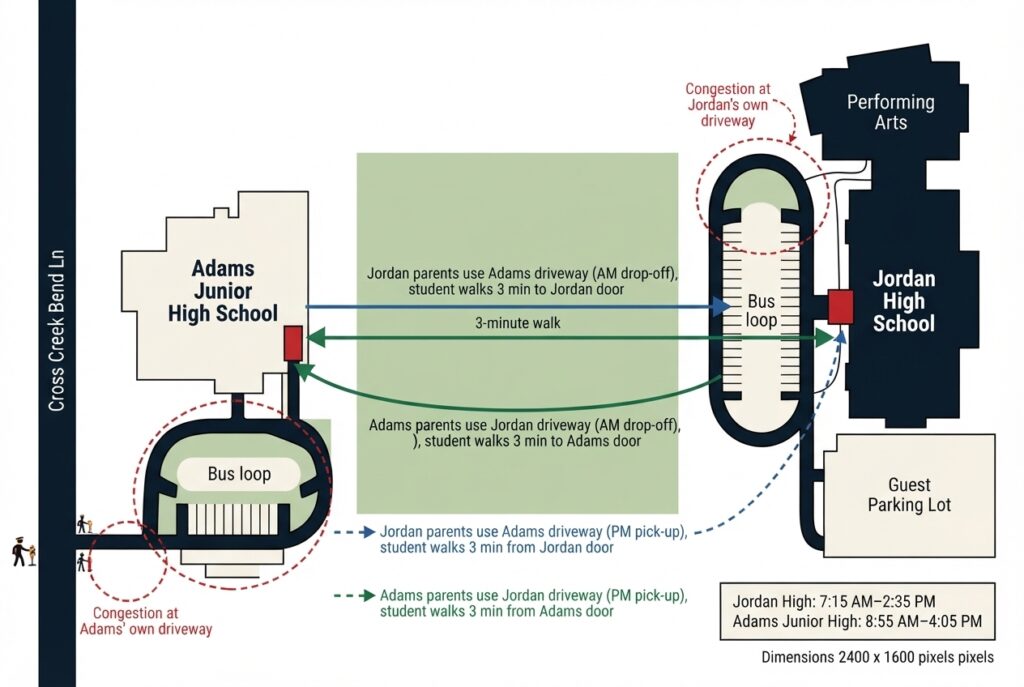
Figure 1. JNSTM Cross-Campus Drop-Off and Pick-Up Mechanism — Two Schools, Two Driveways, Walk-Over Access
6. Stakeholder Roles and Responsibilities
JNSTM involves multiple stakeholders. Each has a distinct role and benefits from the method.
Table 2. Stakeholder Roles and Responsibilities
| Stakeholder | Role | Benefit |
|---|---|---|
| City / County | Approve traffic plan, provide crossing guards, enforce codes | Fewer complaints, safer streets, reduced congestion |
| School District (ISD) | Set bell times, sign MOU, manage staff, coordinate with nearby school | Lower liability, smoother operations, better parent satisfaction |
| Builder / Developer | Design JNSTM-compatible site plan, coordinate with district | Faster approvals, lower retrofit risk, marketable design feature |
| Police Department | Provide traffic control on public roads, train crossing guards | Clear authority, defined cost, improved safety |
| Parents | Follow maps and rules, use cross-campus drop-off and pick-up when directed | Faster drop-off and pick-up, safer kids, less confusion |
| Students | Walk the designated path between campuses, morning and afternoon | Shorter wait, safer arrival and departure |
| Neighborhood / Community | Provide feedback, respect traffic rules | Less congestion on local streets |
6.1 Role Details
City / County Government
- Review and approve the joint traffic plan
- Provide crossing guards or fund shared crossing guard program
- Include JNSTM in school siting guidelines
- Support pilot programs with data collection, covering both AM and PM
School District
- Identify nearby schools with different bell times
- Propose coordination to the nearby school
- Draft and sign MOU
- Manage staff and ensure they remain on school property
- Communicate with parents and students about both drop-off and pick-up procedures
Builder / Developer
- Include JNSTM in the site plan
- Coordinate with the district on bell times
- Provide adequate driveway capacity and cross-campus pathways
- Document design intent for approval
- Submit for approval with traffic impact study
Police Department
- Provide crossing guards or traffic officers for public roads, in both AM and PM
- Train crossing guards
- Enforce traffic laws during peak periods
- Review and approve traffic control plan
7. Cost-Benefit Analysis
Decision-makers need numbers. The following estimates are illustrative and will vary by district, region, and scale.
7.1 Cost Estimates
Table 3. JNSTM Implementation Cost Estimates
| Item | Estimated Cost | Notes |
|---|---|---|
| MOU drafting and legal review | $500–$2,000 | One-time cost |
| Signage and striping | $1,000–$5,000 | One-time cost, per school |
| Cross-campus walking path improvements | $2,000–$15,000 | Sidewalk, paint, signage, lighting, both AM and PM use |
| Crossing guard (shared) | $8,000–$15,000/year | Split between schools or city; covers both AM and PM |
| Traffic aide (shared) | $6,000–$12,000/year | Split between schools; covers both AM and PM |
| New school design integration | $0–$5,000 | Planning stage only |
| Retrofit (existing school) | $10,000–$50,000 | Driveway coordination, striping, signage, path |
| Pilot program (30 days, both AM and PM) | $1,000–$3,000 | Data collection, temporary signage |
| Annual review | $500–$1,500 | Staff time, traffic engineer consultation |
7.2 Benefit Estimates
Table 4. JNSTM Benefit Estimates
| Benefit | Estimated Value | Notes |
|---|---|---|
| Additional driveway capacity | 30–50% increase during peak | Parents may use the other school’s empty driveway, both AM and PM |
| Reduced parent wait time | 5–10 minutes per trip | Faster flow through two driveways, both AM and PM |
| Reduced staff time on traffic | 1–2 hours per day | Staff no longer directing traffic |
| Reduced liability exposure | Avoided lawsuits | Risk reduction is significant |
| Shared crossing guard cost | 50% savings | Split between schools |
| Improved safety | Fewer incidents | Both AM and PM, hard to quantify but high value |
7.3 Cost-Benefit Summary
Table 5. JNSTM Cost-Benefit Summary
| Scenario | Total Cost | Total Benefit | Payback Period |
|---|---|---|---|
| New school integration | $0–$5,000 | $20,000–$50,000/year in savings | Immediate |
| Existing school retrofit | $10,000–$50,000 | $15,000–$40,000/year in savings | 1–2 years |
| Shared crossing guard | $8,000–$15,000/year | $4,000–$7,500/year savings per school | Ongoing |
8. Regulatory and Code Alignment
Builders and government reviewers need to know JNSTM fits existing rules.
8.1 Zoning Code Considerations
- Driveway separation: Some jurisdictions require two separate driveways separated by at least 150 feet. JNSTM-compatible designs can satisfy or exceed these requirements.
- Driveway width: Must accommodate two-way traffic or one-way flow with adequate turning radius for both AM and PM peaks.
- Sight lines: Clear sight lines at driveway exits are required for safety, especially in the afternoon when lighting may be lower.
- Stacking capacity: On-site stacking must accommodate peak traffic without spilling onto public roads, in both AM and PM.
- Pedestrian pathways: Cross-campus walking paths must comply with local sidewalk and ADA requirements, and must be usable in both morning and afternoon.
8.2 Fire Code Considerations
- Emergency vehicle access: Driveways must maintain clear access for fire and emergency vehicles at all times.
- Turning radius: Must accommodate fire apparatus.
- Hydrant access: Fire hydrants must remain accessible.
8.3 ADA Considerations
- Pedestrian routes: Must be accessible to individuals with disabilities, in both AM and PM.
- Curb ramps: Required at all pedestrian crossings.
- Signage: Must be accessible and visible.
8.4 Traffic Impact Study Requirements
Many jurisdictions require a traffic impact study (TIS) for new school construction or major renovation. JNSTM should be included in the TIS as a mitigation measure, covering both morning and afternoon peak periods.
8.5 State School Facility Standards
Some states have specific standards for school site design, including driveway configuration, parking, and pedestrian safety. JNSTM-compatible designs can satisfy or exceed these standards.
9. MOU Analysis
The Memorandum of Understanding is the legal backbone of JNSTM. Without it, coordination between nearby schools remains informal and legally ambiguous.
9.1 What the MOU Must Cover
Table 6. Required MOU Elements
| Element | Purpose |
|---|---|
| Purpose statement | Defines why the agreement exists |
| Scope of use | Which time windows (AM and PM), which areas, which parties |
| Cross-campus drop-off and pick-up protocol | Defines how parents use the other school’s driveway in the morning and afternoon, and how students walk between campuses |
| Student supervision | Defines who supervises students during the walk in AM and PM |
| Walking path maintenance | Defines who maintains the cross-campus path, including lighting and winter maintenance |
| Ownership disclaimer | Confirms no leasehold or ownership interest is granted |
| Term and termination | Duration, renewal, and exit conditions |
| Liability allocation | Who is responsible for what |
| Insurance requirements | Minimum coverage, additional insured status |
| Coordination contacts | Who manages scheduling and communication |
| Compliance | Federal, state, and local law |
9.2 Real-World Examples
A 2016 MOU between Loudoun County, Virginia, and the Loudoun County School Board established mutual access to parking areas, with use limited to times that “would not interfere with the Parties’ use of their own respective space.” The agreement expressly states that it does not constitute a leasehold or ownership interest.
An MOU between Lower Dauphin School District and Hummelstown Borough, Pennsylvania, provides for police traffic control services at specific intersections during arrival and dismissal, with the district paying $14,000 per year (prorated monthly) for the service. The agreement clarifies that the traffic control personnel are independent contractors, not district employees, and that the police department remains responsible for their benefits and workers’ compensation.
9.3 Key Legal Provisions
Independent contractor status. The MOU should specify that traffic control personnel are not employees of the school district. This protects the district from workers’ compensation and benefits liability.
Insurance and additional insured. If a third party provides traffic control, they should name the school district as an additional insured on their liability policy. School districts typically require certificates of insurance naming the district and board of education as additional insured through endorsement.
Indemnification. The MOU should include mutual indemnification clauses, or clearly allocate indemnification responsibility.
Student supervision. The MOU should define who is responsible for supervising students walking between campuses — the drop-off school, the receiving school, or both — in both morning and afternoon.
Lighting and winter maintenance. The MOU should define responsibility for lighting the cross-campus path in the afternoon and for snow or ice removal in winter months, since pick-up in winter may occur after dark.
10. Insurance and Liability Analysis
10.1 The Liability Question
Who is liable if an accident occurs during coordinated traffic operations between two nearby schools? The answer depends on where the accident occurs and who was acting in what capacity.
Table 7. Liability by Location and Actor
| Location | Who is typically liable |
|---|---|
| On school property, school staff directing | School district |
| On school property, contractor directing | Contractor (with district as additional insured) |
| On public road, crossing guard | City or police department |
| On public road, school staff directing | High risk for district — staff not authorized |
| Cross-campus drop-off or pick-up, vehicle accident | Determined by MOU liability clause |
| Student injured while walking between campuses | Determined by MOU supervision clause |
| Student injured on cross-campus path after dark (PM) | Determined by MOU lighting and supervision clause |
10.2 Staff Directing Traffic: The Prohibition
School staff should not direct traffic on public roads. This is not a matter of training — it is a matter of legal authority and liability. School administrators may assume that existing drop-off and pick-up patterns are safest or have reduced risk of liability because they are routine, but this assumption is not legally protective.
If a school employee is injured while directing traffic on a public road, workers’ compensation may cover the injury, but the district may face additional liability claims. If a member of the public is injured, the district could be sued for negligence.
10.3 Insurance Requirements
School districts typically require:
- General liability insurance covering the district and its employees
- Automobile liability insurance for district-owned or leased vehicles
- Errors and omissions / educators legal liability coverage
For coordinated operations between nearby schools, additional coverage may be needed. If a contractor provides traffic control, the district should require:
- Certificate of insurance
- Additional insured endorsement naming the district
- Waiver of subrogation
- Minimum coverage limits (often $1,000,000 per occurrence)
10.4 Practical Risk Management
- Keep staff on school property. Do not send teachers to direct traffic on public roads or on another school’s property.
- Use trained professionals for public roads. Crossing guards and police officers have the legal authority and training.
- Define supervision for cross-campus walking. The MOU should specify who supervises students walking between campuses, in both AM and PM.
- Light the cross-campus path. Afternoon pick-up in winter may occur after dark; the walking path must be well lit.
- Document everything. Keep copies of MOUs, insurance certificates, training records, and incident reports.
- Review annually. Liability exposure changes as traffic patterns and enrollment change.
11. Police and Traffic Control Authority
11.1 Statutory Authority
Law-enforcement officers and uniformed school crossing guards have specific statutory authority to control traffic. In Virginia, for example, law-enforcement officers may assume control of traffic at any intersection, and uniformed school crossing guards may control traffic at any marked school crossing.
11.2 Crossing Guards
Crossing guards are typically hired by or under the authority of a law-enforcement agency. In Michigan, school crossing guards are the responsibility of the local law-enforcement agency having immediate jurisdiction. In some jurisdictions, school districts may recruit and assign adult crossing guards under guidelines approved by the local law-enforcement agency.
Crossing guards are needed for both morning drop-off and afternoon pick-up, since both sessions involve pedestrian crossings and mixed vehicle traffic.
11.3 School Security Personnel
In some districts, school security personnel may be authorized to assist with traffic direction on roadways adjacent to school property. A Memorandum of Understanding between the Broken Arrow Police Department and Union Public Schools, for example, allows designated school security personnel to assist with traffic direction on roadways adjacent to school property during specified times, with permission of the city.
11.4 Cost-Sharing Models
Police traffic control services can be funded through a cost-sharing MOU. The Lower Dauphin School District MOU provides for $14,000 per year, prorated monthly, for traffic control at three intersections. The Fort Mill School District MOU with the Town of Fort Mill provides for sworn officers to manage traffic during arrival and dismissal, with the district funding the costs.
12. Risk and Liability Matrix
Table 8. JNSTM Risk and Liability Matrix
| Risk | Likelihood | Impact | Mitigation |
|---|---|---|---|
| Parent uses wrong school’s driveway | High | Low | Clear signage, maps, parent education |
| Parent uses other driveway outside designated window | Medium | Low | Clear time windows, signage, AM and PM |
| Staff directs traffic on public road | Medium | High | MOU, policy, training, keep staff on property |
| Student injured walking between campuses (AM) | Low | High | Designated path, supervision, MOU clause |
| Student injured walking between campuses (PM, after dark) | Low | High | Path lighting, supervision, MOU clause |
| Accident on cross-campus driveway (AM) | Low | High | Insurance, MOU, separated zones, professional control |
| Accident on cross-campus driveway (PM) | Low | High | Insurance, MOU, separated zones, professional control |
| MOU dispute | Low | Medium | Clear terms, annual review, dispute resolution clause |
| Congestion spills onto public road | High | Medium | Cross-campus drop-off and pick-up, stacking capacity |
| Pedestrian-vehicle conflict | Medium | High | Separated zones, crossing guards, signage |
| Insurance lapse | Low | High | Annual certificate review, additional insured endorsement |
13. Case Example Analysis: Jordan High School and Adam Junior High School
The following case example is illustrative. A campus map (Figure 2) will be added upon receipt.
13.1 Setting
Jordan High School and Adam Junior High School are located near each other but are separate schools with separate campuses and separate driveways. Both schools operate on different bell schedules — a typical U.S. configuration. Each school has its own traffic congestion during its own peak, both in the morning and in the afternoon.
Parents from one school sometimes use the other school’s driveway informally, but without coordination. School staff have been observed directing traffic near the other school.
13.2 Problem Indicators
- Each school has its own driveway congestion during its own peak, morning and afternoon
- Parents using the nearby school’s driveway informally
- Staff directing traffic outside their own property
- Each school’s driveway partially idle during the other school’s peak
- Potential safety risks for students and pedestrians
- No formal coordination between the two schools
13.3 JNSTM Application
- Confirm bell times — verify the two schools have different bell times.
- Measure the walk — confirm the walking distance between campuses is about three minutes, in both AM and PM.
- Formalize coordination — draft an MOU between the two schools and the district, covering drop-off and pick-up.
- Designate drop-off and pick-up zones — mark cross-campus zones at each school for both sessions.
- Designate walking path — mark and supervise the cross-campus walking path, with lighting for afternoon pick-up.
- Professional traffic control — request crossing guards or police officers for public-road intersections, in both AM and PM.
- Parent education — publish maps and rules in both schools’ handbooks, covering both sessions.
- Pilot — run a 30-day pilot and measure congestion in both sessions.
13.4 Expected Outcomes
- Each school gains additional driveway capacity during its own peak, morning and afternoon
- Reduced driveway congestion for both schools, both sessions
- Fewer parents using the nearby driveway informally
- Staff no longer directing traffic outside their authority
- Improved safety for students and pedestrians, in both AM and PM
- Shared cost for crossing guards and maintenance
13.5 Campus Map
Figure 2 maps Jordan High School and Adams Junior High School, each with its own separate driveway. A grass walkway connects them. Blue and green arrows visually show the four cross-campus drop-off and pick-up patterns during morning and afternoon, based on staggered bell times. The map illustrates the JNSTM method.
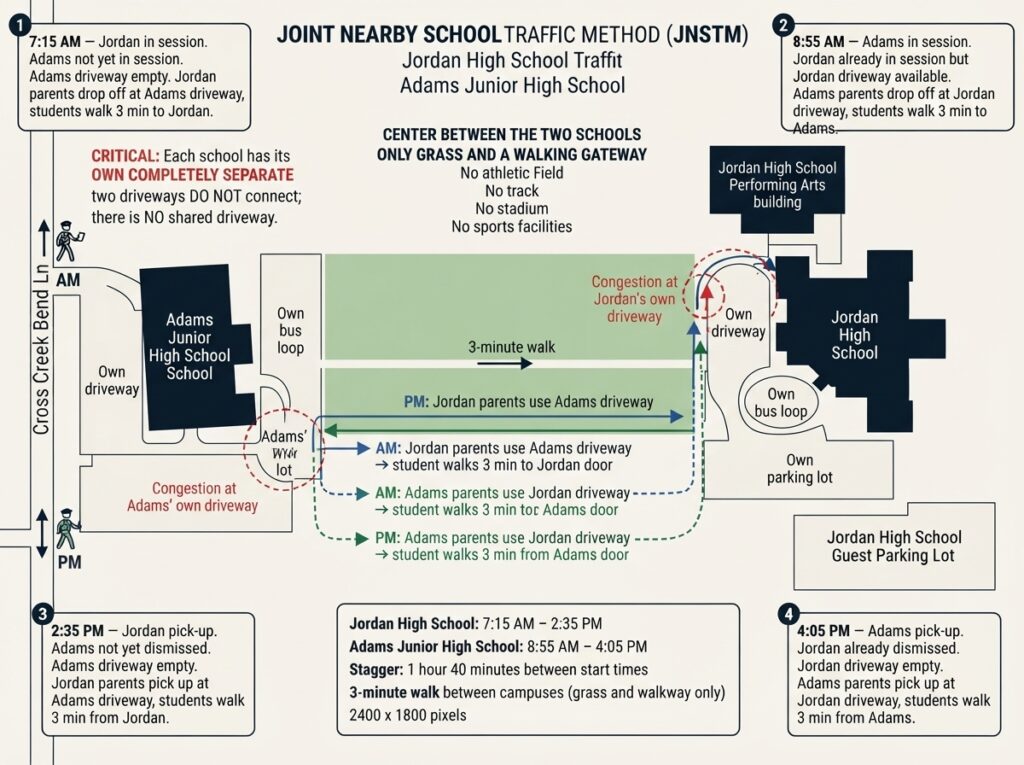
Figure 2. Jourdan High School and Adam Junior High School — JNSTM Cross-Campus Drop-Off and Pick-Up in Practice
14. New School Planning Integration
For new schools, JNSTM should be integrated at the design stage. The Federal Highway Administration’s guidance on school site planning emphasizes the design of new schools for maximum walkability, traffic safety, and efficiency. Design-phase integration is low-cost and high-impact.
14.1 Design Considerations
Table 9. JNSTM-Compatible Design Elements
| Element | JNSTM-Compatible Design |
|---|---|
| Driveway | Adequate capacity for the school’s own traffic plus cross-campus drop-off and pick-up |
| Lanes | Two lanes for parent cars, one for buses |
| Zones | Clearly marked bus, car, walker, drop-off, pick-up, and cross-campus areas |
| Bell times | Staggered with nearby schools by 20–30 minutes |
| Traffic control | Space for crossing guards at public-road crossings, AM and PM |
| Pedestrian routes | Separated from vehicle traffic, with a safe, lit cross-campus path for both sessions |
| Signage | Clear, consistent, and visible from all approaches, in daylight and after dark |
| Coordination | Consideration of nearby school traffic patterns and walking distance |
14.2 Zoning and Code Considerations
Some jurisdictions have specific requirements for school driveways. One township requires two separate driveways separated by at least 150 feet. JNSTM-compatible designs can satisfy or exceed these requirements.
14.3 Builder Integration Checklist
Builders must integrate JNSTM into site plans, coordinate bell times, provide separate zones and safe paths, and submit traffic studies.
- Include JNSTM in the site plan
- Coordinate with the district on bell times
- Provide adequate driveway capacity for own traffic and cross-campus traffic
- Design separate bus, car, walker, and cross-campus zones for both AM and PM
- Design a safe, lit cross-campus walking path
- Include space for crossing guards, AM and PM
- Consider coordination with nearby schools
- Document design intent for approval
- Submit for approval with traffic impact study
- Coordinate with city traffic engineer
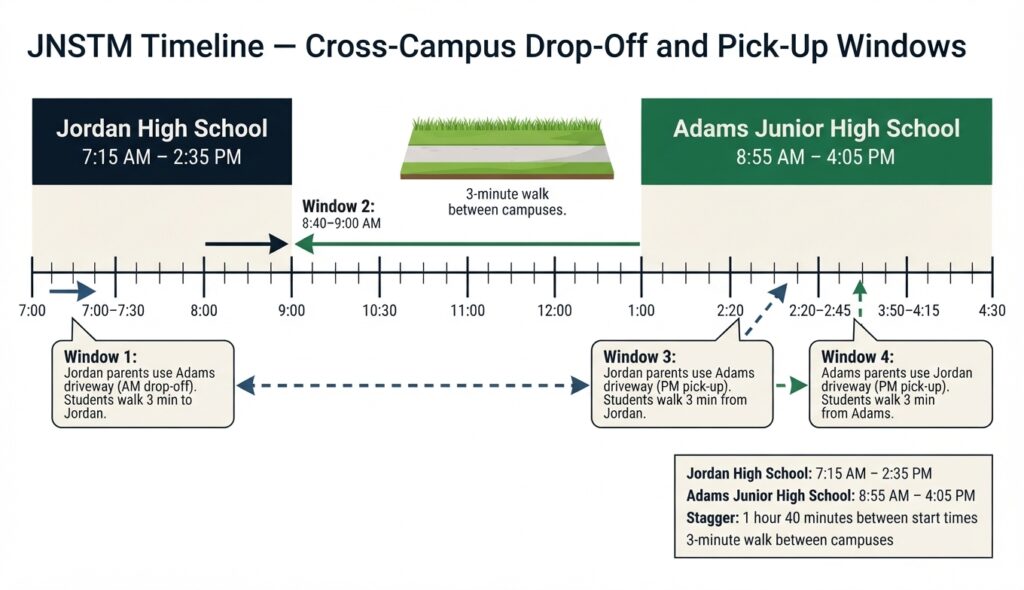
Figure 3. JNSTM Timeline — Staggered Bell Times and Cross-Campus Drop-Off and Pick-Up Windows
15. Measurable Outcomes and KPIs
Government and ISD leaders want to know how to measure success.
Table 10. JNSTM Key Performance Indicators (KPIs)
| KPI | Baseline | Target | Measurement Method |
|---|---|---|---|
| Peak congestion duration (AM) | 30 min | 15 min | Timed observation |
| Peak congestion duration (PM) | 30 min | 15 min | Timed observation |
| Cars queued on public road (AM) | 20 | Under 5 | Traffic count |
| Cars queued on public road (PM) | 20 | Under 5 | Traffic count |
| Parent wait time (AM) | 12 min | 6 min | Survey or observation |
| Parent wait time (PM) | 12 min | 6 min | Survey or observation |
| Staff directing traffic on public road | Yes | No | Administrative review |
| Cross-campus drop-off usage rate | 0% | 30%+ | Traffic count |
| Cross-campus pick-up usage rate | 0% | 30%+ | Traffic count |
| Incidents / near-misses | Unknown | Zero | Incident reports |
| Parent satisfaction | Unknown | 80%+ | Survey |
| Crossing guard cost per school | $15,000 | $7,500 | Budget review |
| MOU compliance | N/A | 100% | Annual review |
16. Adoption Pathway
A step-by-step path for each audience.
16.1 For School Districts
- Identify nearby schools with different bell times (most common: high school + junior high)
- Measure the walking distance between campuses
- Meet with the nearby school and the district
- Confirm or establish staggered bell times
- Draft MOU for cross-campus drop-off and pick-up
- Pilot for 30 days
- Review and expand
16.2 For Builders
- Include JNSTM in the site plan
- Coordinate with the district on bell times
- Provide adequate driveway capacity and cross-campus pathway
- Document design intent
- Submit for approval
16.3 For Government
- Include JNSTM in school siting guidelines
- Require traffic coordination plan for new schools
- Offer shared crossing guard funding
- Support pilot programs
16.4 For Police Departments
- Review and approve the traffic control plan
- Provide crossing guards or traffic officers for public roads, AM and PM
- Train crossing guards on JNSTM protocol
- Participate in pilot review and annual assessment
17. Funding and Incentives
Money matters. The following funding sources can support JNSTM implementation.
Table 11. Funding Sources for JNSTM Implementation
| Source | Description | Typical Amount |
|---|---|---|
| Shared crossing guard costs | Split between schools or city | $8,000–$15,000/year |
| Traffic impact fees | Developers fund mitigation | Varies |
| Safe Routes to School grants | Federal and state grants | $10,000–$500,000 |
| School bond funds | Capital improvements | Varies |
| Municipal traffic safety grants | Local government grants | $5,000–$100,000 |
| State school facility funds | State education funds | Varies |
18. Frequently Asked Questions
18.1 For School Districts
Will staggered bell times affect bus schedules?
In most cases, the stagger already exists. If a new stagger is needed, bus routing can often be adjusted. Coordination with the transportation department is essential.
Who pays for crossing guards?
Costs can be shared between schools, the district, and the city. Some districts fund crossing guards through their own budget; others use cost-sharing MOUs with local police departments.
What if the nearby school refuses to cooperate?
Start with an informal working group. Share data on congestion and safety. If cooperation is not possible, implement JNSTM unilaterally where possible — for example, by adjusting your own parent education and keeping staff on your own property.
How long is the walk between campuses?
For JNSTM to work, the walk should be about three minutes. Longer walks reduce parent willingness to use cross-campus drop-off or pick-up.
Does this work for pick-up, or only drop-off?
Both. The mechanism is identical. Parents use the other school’s empty driveway during their own pick-up window, and students walk between campuses.
18.2 For Government
Does this require code changes?
Not necessarily. JNSTM can often be implemented within existing codes. However, updating school siting guidelines to include JNSTM can help.
Who is liable on public roads?
The city or police department is typically liable for traffic control on public roads. School staff should not direct traffic on public roads.
Can we require this in new permits?
Yes. Jurisdictions can require a traffic coordination plan as a condition of permit approval for new school construction.
18.3 For Builders
Does this increase construction cost?
Design-phase integration is low-cost. Providing adequate driveway capacity and a cross-campus pathway may add some cost, but it can also reduce the need for expensive traffic mitigation later.
Will it delay approvals?
A well-designed JNSTM plan can actually speed approvals by demonstrating that traffic impacts are mitigated.
What design standards apply?
Local zoning codes, fire codes, ADA, and state school facility standards. JNSTM-compatible designs should satisfy or exceed these standards.
18.4 For Police Departments
What is our role in JNSTM?
Police departments provide traffic control on public roads and train crossing guards, in both AM and PM. They also review and approve the traffic control plan.
How are costs shared?
Police traffic control services can be funded through a cost-sharing MOU with the school district. Costs are typically split between the district and the city.
19. Recommendations
- For existing schools: Confirm bell times. Measure the walking distance between campuses. Formalize coordination with a nearby school through an MOU, covering both drop-off and pick-up. Designate zones and walking paths. Add professional traffic control in both sessions. Run a pilot before full implementation.
- For new schools: Integrate JNSTM into the design from day one. Adequate driveways, staggered bell times, cross-campus pathways, and clear zones cost little at the planning stage and avoid expensive retrofits later.
- For districts: Develop a standard MOU template for nearby-school traffic coordination, covering both drop-off and pick-up. Require insurance certificates and additional insured endorsements from any third-party traffic control provider. Define supervision for students walking between campuses, in both sessions.
- For schools: Keep staff on school property. Use trained professionals for public roads. Document everything.
- For parents: Publish clear maps and rules, covering both drop-off and pick-up. Repeat them at the start of every school year. Changing parent behavior takes time and consistency.
- For government: Include JNSTM in school siting guidelines. Require traffic coordination plans for new schools. Support pilot programs with data collection, covering both AM and PM.
- For builders: Include JNSTM in site plans. Coordinate with districts on bell times. Document design intent for approval.
- For police departments: Review and approve the traffic control plan. Provide crossing guards or traffic officers in both AM and PM. Train crossing guards on JNSTM protocol. Participate in pilot review.
20. Conclusion
The Joint Nearby School Traffic Method is a effective, replicable method for coordinating traffic between two nearby schools that do not share a campus or driveway. Its core insight is cross-campus drop-off and pick-up using the other school’s empty driveway — not shared infrastructure. In most U.S. districts, nearby schools (especially high school + junior high) already operate on different bell times. Each school has its own driveway and its own congestion during its own peak. Each school’s driveway sits partially idle when the other school is at peak — both in the morning and in the afternoon.
JNSTM solves this by establishing a formal coordination framework between the two schools. Parents from the active school use the empty driveway of the inactive school, and students walk a short distance between campuses. Each school gains additional capacity without new construction. The method reduces congestion, improves safety, clarifies liability, and lowers costs. For new schools, it is almost free to integrate at the design stage. For existing schools, it can be implemented in stages.
JNSTM is offered as part of WiseInnovationMethods, a growing collection of practical, thoughtful methods for schools, communities, and everyday life.
References
Federal Highway Administration. (2013). School site planning, design and transportation (Pg 59–77). U.S. Department of Transportation. https://highways.dot.gov/safety/pedestrian-bicyclist/safety-tools/pg-59-77-school-site-planning-design-and-transportation
Fort Mill, Town of. (2025, August 22). Town and Fort Mill School District partner to support safer school traffic. https://www.fortmillsc.gov/CivicAlerts.aspx?AID=690&ARC=1067
Lower Dauphin School District & Hummelstown Borough. (n.d.). Memorandum of understanding. https://meetings.keystoneagenda.com/Documents/FileViewerOrPublic/4098?file=14265355
Loudoun County & Loudoun County School Board. (2016). Memorandum of understanding for a mutual access license agreement. https://www.boarddocs.com/vsba/loudoun/Board.nsf/files/A82R2T5DB9F8/$file/MOU%20of%20County%20and%20Schools%20for%20Mutual%20Use%20of%20Parking-%20Lovettsville%202016%20FINAL.pdf
Vacaville, City of. (2012, August 14). Resolution approving a reciprocal access and parking license agreement between Vacaville Unified School District and City of Vacaville. https://vacaville.granicus.com/MetaViewer.php?clip_id=1038&meta_id=49058&view_id=2
Virginia Law. (2026). § 46.2-834. Signals by law-enforcement officers, crossing guards, and flaggers. https://law.lis.virginia.gov/vacode/46.2-834/
WiseRighteous Network. (2026). WiseInnovationMethods: Joint Nearby School Traffic Method (JNSTM). https://www.wiserighteous.org/wiseinnovationmethods/
WiseRighteous Network
WiseInnovationMethods · Method Analysis