Beyond Compliance: The Independent Righteousness Committee (IRC) and the New Paradigm of AI Governance
A Blueprint for Absolute Moral Governance in Artificial Intelligence
Author: Independent Righteousness Committee Initiative
Date: September 29, 2026
Version: 1.0
Abstract
Artificial intelligence (AI) is advancing at a pace that outstrips existing governance mechanisms. Traditional ethics committees—whether corporate or governmental—operate on relative, procedural ethics that are vulnerable to commercial pressure and political turnover. This document proposes the Independent Righteousness Committee (IRC) and the Righteousness AI Governance Framework (RAGF) as a new paradigm. The IRC is an independent body with real veto power, intent-audit authority, and stewardship oversight, anchored by legal charters, cryptographic mechanisms, and public accreditation. The RAGF translates absolute righteousness into concrete constraints across the AI development lifecycle. This blueprint distinguishes righteousness from ethics, draws on the Federal Reserve’s independence model, and outlines three shielding mechanisms against political and commercial interference. It concludes with a phased implementation strategy and a call to action for technologists, policymakers, and civil society.
Keywords: Independent Righteousness Committee, Righteousness AI Governance Framework, AI ethics, veto power, intent audit, stewardship, Federal Reserve independence, AI governance
1. Introduction
The rapid development of artificial intelligence has created a moral vacuum. Existing governance structures—corporate ethics boards, government advisory panels, and industry self-regulation—have proven inadequate to address the long-term systemic risks posed by autonomous systems (Bostrom, 2014; Cath, 2018). These bodies operate on a logic of relative ethics: they seek to balance competing interests, avoid legal liability, and maintain public relations. They are not designed to uphold absolute moral standards.
This document argues for a fundamental shift: from relative ethics to absolute righteousness. We propose the Independent Righteousness Committee (IRC) as the highest moral gatekeeper for AI development, and the Righteousness AI Governance Framework (RAGF) as its operational arm. The IRC is not merely another ethics committee. It possesses real veto power, conducts intent audits, and exercises stewardship oversight. It is structurally independent from both commercial interests and political whims.
The paper proceeds as follows. Section 2 defines righteousness and distinguishes it from ethics. Section 3 analyzes the structural failure of existing boards and introduces the Federal Reserve analogy. Section 4 presents the IRC’s institutional blueprint. Section 5 details three shielding mechanisms. Section 6 outlines the RAGF implementation path. Section 7 concludes with a vision and limitations.
2. Conceptual Foundation: Ethics vs. Righteousness
2.1 Defining the Terms
Ethics refers to a system of moral principles that are often relative, context-dependent, and procedurally defined. In corporate and governmental settings, ethics committees typically apply legal compliance, risk management, and stakeholder balancing (Jobin et al., 2019). Their standards shift with legislation, market trends, and public opinion.
Righteousness, by contrast, denotes an absolute moral standard grounded in human dignity, truth, and the protection of the vulnerable. It does not bend to commercial expediency or political pressure. Righteousness is not about avoiding harm within acceptable limits; it is about actively upholding the good.
2.2 Why AI Requires Righteousness
AI systems can scale harm, manipulate human behavior, and make unsupervised decisions at unprecedented speed (Floridi et al., 2018). Mittelstadt (2019) argues that principles alone cannot guarantee ethical AI because they lack enforcement mechanisms. Righteousness fills this gap by providing an unwavering moral compass and the power to enforce it.
2.3 Ethics Committee vs Independent Righteousness Committee
Table 1: Comparison of Ethics Committee (EC) and Independent Righteousness Committee (IRC)
| Dimension | Traditional Ethics Committee (EC) | Independent Righteousness Committee (IRC) |
|---|---|---|
| Philosophical basis | Relative, procedural ethics | Absolute righteousness, human dignity |
| Source of standards | Law, regulation, industry norms | Universal moral truth, protection of the vulnerable |
| Core driver | Compliance, risk avoidance, PR | Truth, justice, stewardship, human flourishing |
| Power | Advisory, recommendatory | Veto power, suspension, termination |
| Independence | Vulnerable to executives and politics | Structurally independent from commerce and politics |
| Review focus | Checklist: legality, bias | Intent and motive: exploitation, manipulation, dignity |
| Response to pressure | Compromise and mitigation | Non-negotiable on core red lines |
| Composition | Executives, lawyers, product managers | Independent guardians, ethicists, technologists, vulnerable representatives |
| Transparency | Internal reports | Public disclosure when necessary |
| Accountability | To management or board | To righteous principles, charter, and public trust |
| Failure mode | Rubber-stamping, formalism | Risk of marginalization, limited legal force |
| Scope | Corporate compliance, research ethics | AI development, deployment, data governance |
Note. This table synthesizes the conceptual distinctions developed throughout this document.
3. The Structural Failure of Existing Boards
3.1 Corporate Ethics Committees
Corporate ethics committees are often internal, advisory, and conflict-ridden. They report to executives whose incentives are misaligned with moral restraint. When commercial pressures mount, their recommendations are frequently ignored or overruled. They become “rubber stamps” that legitimize decisions already made (Mittelstadt, 2019).
3.2 Government Ethics Committees
Government ethics committees are subject to political cycles. A new administration can dissolve, weaken, or reconstitute them overnight. For example, recent political shifts in the United States have led to the revocation or weakening of federal ethics panels. This demonstrates that government-backed ethics are only as stable as the political regime in power. As Kettl (1986) notes, independent agencies like the Federal Reserve were created precisely to insulate monetary policy from short-term political pressure.
3.3 The Federal Reserve Analogy
The Federal Reserve (Fed) is an independent central bank that operates within government but is shielded from direct political control. Its leaders serve long, staggered terms, and its decisions are not subject to presidential veto. This model offers a powerful analogy for the IRC: moral governance of AI must be similarly insulated from political and commercial cycles (Meltzer, 2003).
3.4 IRC Governance Structure
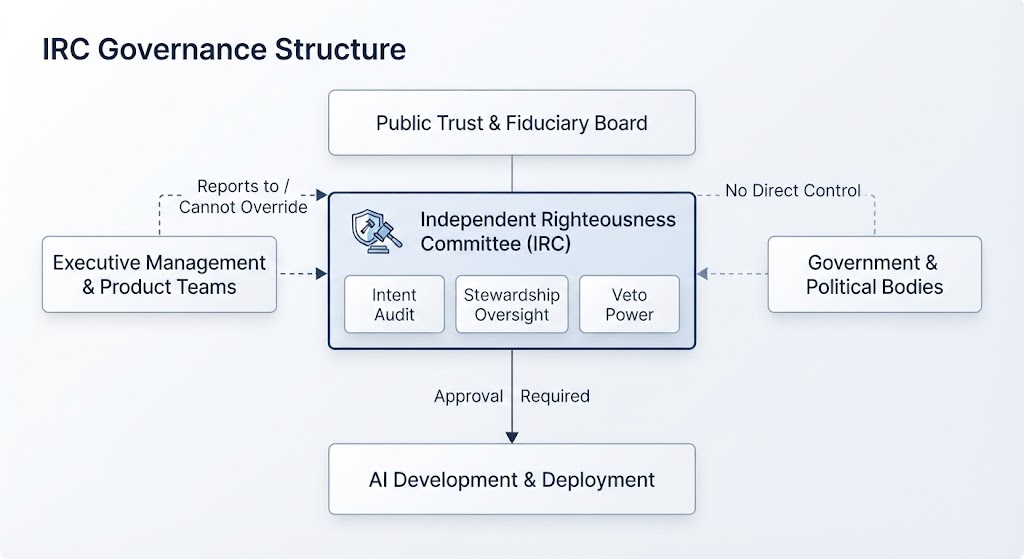
Figure 1. IRC Governance Structure. This diagram shows the IRC’s position as an independent body with veto power over AI projects, reporting to the public and a fiduciary board, while remaining separate from executive management and political authorities.
4. The Independent Righteousness Committee (IRC): Institutional Blueprint
4.1 Core Mandate
The IRC’s mandate is threefold:
- Veto Power: The IRC can suspend or terminate any AI project that violates core principles of human dignity, truth, or protection of the vulnerable.
- Intent Audit: The IRC examines not only code and data but also the underlying motives and design intentions of the development team.
- Stewardship Oversight: The IRC monitors the entire product lifecycle to ensure that righteousness is embedded as a non-negotiable design constraint.
4.2 Composition and Appointment
The IRC should be composed of independent guardians, including ethicists, technologists, legal scholars, and representatives of vulnerable communities. Members should serve long, staggered terms (e.g., 7–10 years) to ensure continuity and independence. Appointment should be made by a fiduciary board, not by executives or politicians. Removal should only occur for cause, with a supermajority vote.
4.3 Accountability and Transparency
The IRC must be accountable to the public. It should publish annual reports, redacted audit findings, and decisions on major cases. An appeals process should exist for developers who believe a decision was unjust. However, appeals should not be able to override the IRC’s core veto on matters of absolute righteousness.
4.4 Core Responsibilities of the IRC
Table 2: Core Responsibilities of the IRC
| Responsibility | Description | Enforcement Mechanism |
|---|---|---|
| Veto Power | Suspend or terminate projects violating righteousness | Binding on all projects; cannot be overridden by management |
| Intent Audit | Examine motives, design intentions, and optimization goals | Required before training and deployment |
| Stewardship Oversight | Monitor lifecycle compliance with righteousness constraints | Continuous audits and spot checks |
| Public Reporting | Publish annual transparency reports | Public disclosure; reputational accountability |
| Appeals Review | Hear appeals from developers | Independent panel; cannot overturn core veto |
| Charter Amendment | Propose changes to IRC’s own charter | Requires supermajority of fiduciary board and public comment |
Note. This table outlines the operational responsibilities and enforcement mechanisms of the IRC.
5. Shielding Mechanisms Against Political and Commercial Interference
5.1 Legal Chartering (The Constitution Model)
The IRC should be embedded in the company’s foundational corporate charter or nonprofit bylaws. This gives it binding legal standing. Dissolving the IRC would require a shareholder supermajority or trigger fiduciary breach lawsuits (Bainbridge, 2002). This protects the committee from the company’s own leadership.
5.2 Cryptographic Dead-Man’s Switch (Code as Law)
The IRC should hold cryptographic keys or governance tokens required to authorize major model training runs or production deployments. Without IRC sign-off, the technical infrastructure cannot compile or deploy. This removes the human temptation to bypass the committee under pressure (Lessig, 1999).
5.3 Open-Source and Public Accreditation (The Public Trust)
The IRC can grant or revoke a “Righteous AI Accreditation.” If a company overrides or dissolves its IRC, the committee can publicly strip the accreditation and release audit findings. In an era of declining public trust in AI, losing this certification can destroy market reputation and trigger consumer boycotts.
5.4 Comparison of Shielding Mechanisms
Table 3: Comparison of Shielding Mechanisms
| Mechanism | How It Works | Strength | Limitation |
|---|---|---|---|
| Legal Chartering | IRC written into corporate charter; dissolution requires supermajority | Legally binding; strong against internal takeover | Difficult to establish initially; requires legal expertise |
| Cryptographic Dead-Man’s Switch | IRC holds keys for training/deployment; no sign-off, no launch | Technical enforcement; bypass-proof | Requires technical infrastructure; may be circumvented by building new systems |
| Public Accreditation | IRC can revoke certification and publish audits | Market-based pressure; reputational | Only works if public cares; may be ignored by some companies |
Note. These mechanisms can be combined for layered defense.
5.5 Three-Layer Defense Model
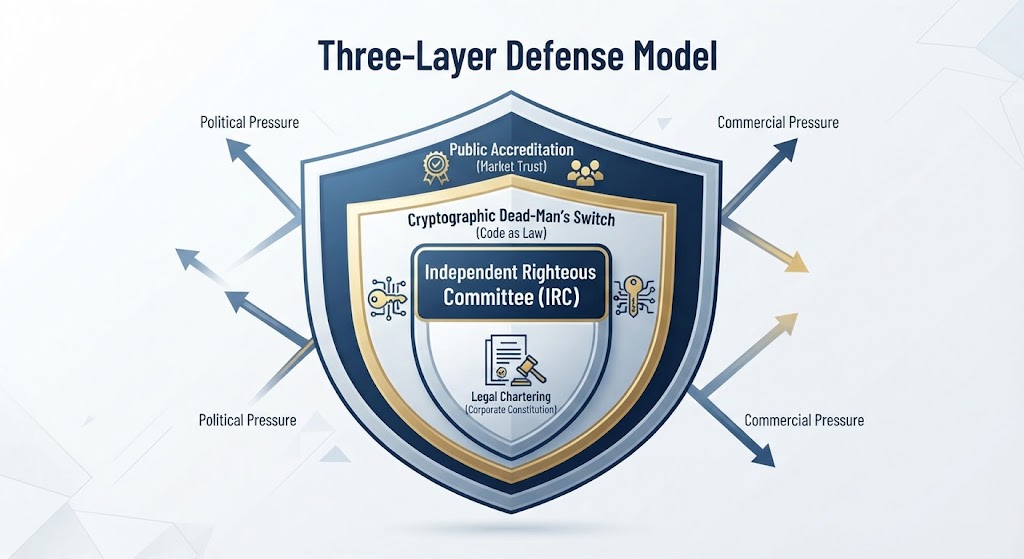
Figure 2. Three-Layer Defense Against Political and Commercial Interference. This diagram illustrates how legal, technical, and public mechanisms reinforce each other to protect the IRC’s independence.
6. Righteousness AI Governance Framework (RAGF): Implementation Path
6.1 Translating Righteousness into Lifecycle Constraints
The RAGF operationalizes righteousness across the AI development lifecycle. It defines red lines, risk tiers, and required audits. For example, any system designed to manipulate human emotion for commercial gain would be automatically vetoed.
6.2 Developer Stewardship Oath
Developers should take a stewardship oath, committing to uphold righteousness over profit. This oath is not merely symbolic; it is enforced by the IRC’s audit and veto powers.
6.3 Risk Tiers and Red Lines
The RAGF classifies AI projects into risk tiers. Higher-risk projects require more rigorous intent audits and ongoing oversight. Red lines include systems that violate human dignity, enable mass surveillance, or manipulate vulnerable populations.
6.4 RAGF Risk Tiers and Required Actions
Table 4: RAGF Risk Tiers and Required Actions
| Risk Tier | Description | Required Actions |
|---|---|---|
| Tier 0: Prohibited | Violates core righteousness red lines | Immediate veto; project cannot proceed |
| Tier 1: High Risk | Potential for significant harm or manipulation | Full intent audit; IRC approval; continuous monitoring |
| Tier 2: Moderate Risk | Limited scope; some ethical concerns | Standard audit; periodic review |
| Tier 3: Low Risk | Minimal ethical impact | Self-certification; random spot checks |
Note. Risk tiers guide the level of IRC involvement.
6.5 Phased Rollout Strategy
- Phase 1 (Spearhead): Focus on AI creators, developers, and AI-driven organizations. Establish proof of concept.
- Phase 2 (Expansion): Once principles and structures are proven, expand to traditional tech, corporate management, and other industries.
6.6 RAGF Development Lifecycle
A professional flowchart showing the six stages of the AI development lifecycle under the Righteousness AI Governance Framework (RAGF). The stages are: Ideation, Data Collection, Model Training, Testing, Deployment, and Monitoring. Above each stage is an “IRC Touchpoint” indicating where the IRC intervenes. Below each stage is a specific required action: Intent Audit, Data Justice Review, Alignment Check, Red Team & Bias Test, Veto Gate, and Stewardship Audit. Arrows show progression through the lifecycle, ending with a box labeled “Continuous Righteousness Assurance.”
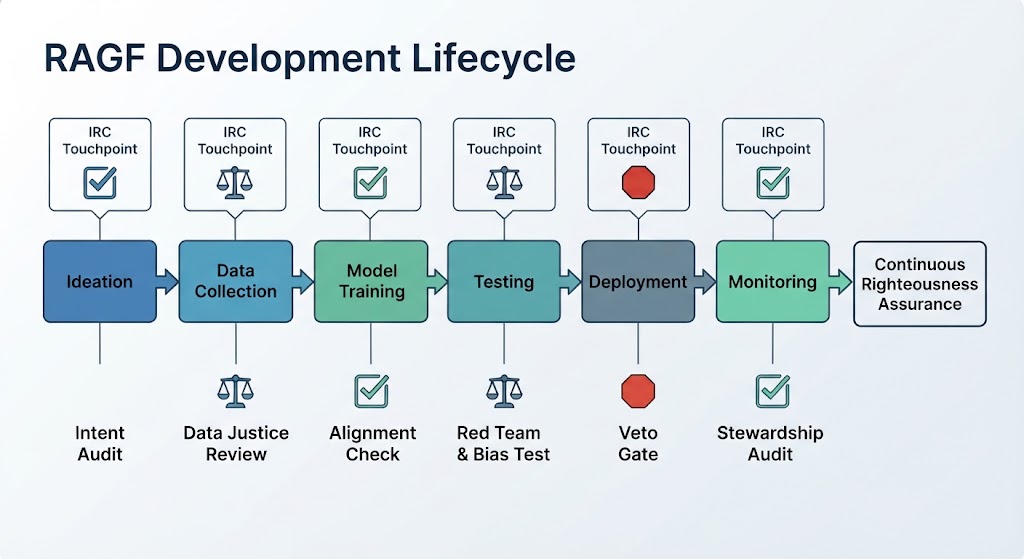
Figure 3. RAGF Development Lifecycle. This diagram shows the stages of AI development with IRC touchpoints: ideation, data collection, model training, testing, deployment, and monitoring. At each stage, specific righteousness checks are applied.
7. Conclusion and Vision
7.1 The Last Line of Defense
The IRC and RAGF represent a last line of defense for human dignity in the age of AI. They are not merely another layer of bureaucracy. They are a structural innovation that places absolute righteousness above relative ethics.
7.2 Call to Action
We call on technologists, policymakers, civil society, and international bodies to adopt and adapt this blueprint. The AI frontier is too important to be left to profit-driven or politically volatile governance.
7.3 Limitations and Future Research
Private governance cannot replace public law. The IRC’s veto power is only as strong as its legal, technical, and market anchors. Future research should explore international treaties, cross-border accreditation, and the integration of IRC principles into existing regulatory frameworks.
References
Bainbridge, S. M. (2002). Corporation law and economics. Foundation Press.
BoardSource. (2010). The handbook of nonprofit governance. Jossey-Bass.
Bostrom, N. (2014). Superintelligence: Paths, dangers, strategies. Oxford University Press.
Cath, C. (2018). Governing artificial intelligence: Ethical, legal and technical opportunities and challenges. Philosophical Transactions of the Royal Society A, 376(2133), 20180080.
Floridi, L., Cowls, J., Beltrametti, M., Chatila, R., Chazerand, P., Dignum, V., … & Vayena, E. (2018). AI4People—An ethical framework for a good AI society: Opportunities, risks, principles, and recommendations. Minds and Machines, 28(4), 689–707.
Jobin, A., Ienca, M., & Vayena, E. (2019). The global landscape of AI ethics guidelines. Nature Machine Intelligence, 1(9), 389–399.
Kettl, D. F. (1986). Leadership at the Fed. Yale University Press.
Lessig, L. (1999). Code and other laws of cyberspace. Basic Books.
Meltzer, A. H. (2003). A history of the Federal Reserve, Volume 1: 1913–1951. University of Chicago Press.
Mittelstadt, B. (2019). Principles alone cannot guarantee ethical AI. Nature Machine Intelligence, 1(11), 501–507.
National Commission for the Protection of Human Subjects of Biomedical and Behavioral Research. (1979). The Belmont Report: Ethical principles and guidelines for the protection of human subjects of research. U.S. Government Printing Office.
Singer, P. (2000). Writings on an ethical life. Ecco Press.